Today's NYT Spelling Bee Answers & Hints
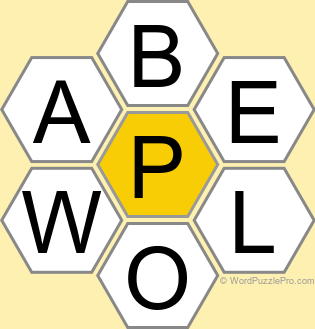
Today's NYT Spelling Bee uses center letter P with outer letters A, B, E, L, O, W. The puzzle contains 54 words worth 201 points, including 1 pangram. The longest word is 10 letters. To reach Genius you need 141 points; Queen Bee requires all 201 points. Today is a bingo — every letter starts at least one word. Compared with the eight-year average of about 183 points per puzzle, this is a larger-than-average day.
Game Summary

| Center Letter | P |
|---|---|
| Outer Letters | a, b, e, l, o, w |
| # of Pangrams | 1 (Perfect: none) |
| Total Words | 54 words |
| Total Points | 201 points |
| Genius Level | 141 points |
| Bingo? | Yes |
Table of Contents
As you scroll down this page, the clues get progressively more revealing. So scroll slowly!
- Spelling Bee Grid
- Two-Letter List (2LL) Hints
- Three-Letter List (3LL) Hints
- Extra Letter Hints (Incrementally Revealing) 🤯
- Today's Complete Solution
- Answer Definitions
If you're just here for a list of NYT Spelling Bee answers, Jump down to the answers ↓ (Spoiler Alert!).
Spelling Bee Grid
The following table shows the standard Spelling Bee summary grid, which lists word lengths across the top and letters down the left-hand side. The cell where the word lengths and letters intersect displays the number of words in today's puzzle with the corresponding first letter and word length.
| 4 | 5 | 6 | 7 | 8 | 9 | 10 | Σ | |
|---|---|---|---|---|---|---|---|---|
| A | - | 1 | 2 | - | 1 | - | 1 | 5 |
| B | 2 | 3 | - | - | - | - | - | 5 |
| E | 1 | 1 | - | - | - | - | - | 2 |
| L | 3 | 1 | 1 | - | - | - | - | 5 |
| O | 1 | - | - | - | - | - | - | 1 |
| P | 18 | 6 | 7 | - | 3 | - | - | 34 |
| W | 1 | - | 1 | - | - | - | - | 2 | Σ | 26 | 12 | 11 | - | 4 | - | 1 | 54 |
Two-Letter List (2LL) Hints
The following list shows the number of solution words that begin with the corresponding two letters.
| A | AP×5 |
|---|---|
| B | BE×2 BL×2 BO×1 |
| E | EL×1 EP×1 |
| L | LA×1 LE×1 LO×3 |
| O | OP×1 |
| P | PA×12 PE×8 PL×6 PO×8 |
| W | WA×1 WE×1 |
Three-Letter List (3LL) Hints
The following list shows the number of solution words that begin with the corresponding three letters.
| A | APP×5 |
|---|---|
| B | BEB×1 BEE×1 BLE×1 BLO×1 BOO×1 |
| E | ELO×1 EPE×1 |
| L | LAP×1 LEA×1 LOL×1 LOO×1 LOP×1 |
| O | OPA×1 |
| P | PAE×1 PAL×6 PAP×3 PAW×2 PEA×1 PEB×1 PEE×4 PEO×1 PEW×1 PLE×3 PLO×3 POL×3 POO×2 POP×2 POW×1 |
| W | WAL×1 WEE×1 |
Extra Letter Hints (Incrementally Revealing)
The table below lists all of the solutions to today's puzzle, but they're concealed. You can click the plus button (+) to reveal additional letters, one-by-one.
Concealed definitions are provided as additional clues. You can toggle concealment of the definitions by clicking on the concealer bar or the text that appears when the definition is visible.
Pangrams are marked with a dagger symbol (†).
| Word | 2L Ref | Definition (click to reveal) |
|---|---|---|
| pl...... † | PL8 | That can be plowed. |
| ap.... | AP6 | To fill with horror; to dismay. |
| ap.... | AP6 | An application to a superior court or judge for a decision or order by an inferior court or judge to be reviewed and overturned. The legal document or form by which such an application is made; also, the court case in which the application is argued. A person's legal right to apply to court for such a review. |
| ap........ | AP10 | That may be appealed, or sent to a higher court for judgement. |
| ap...... | AP8 | A respondent. |
| ap... | AP5 | A common, round fruit produced by the tree Malus domestica, cultivated in temperate climates. |
| be... | BE5 | An early form of modern jazz played by small groups and featuring driving rhythms and complex, often dissonant harmonies. |
| be.. | BE4 | The sound produced by the horn of a car, or any similar sound. |
| bl... | BL5 | A brief high-pitched sound, as from some electronic device. |
| bl... | BL5 | To blow air bubbles or audibly slosh about in water. |
| bo.. | BO4 | A low-pitched beeping sound. |
| el... | EL5 | To run away from home with a paramour. |
| ep.. | EP4 | A sharp-pointed dueling sword with a bell-shaped guard, used (with the end blunted) in sport fencing. |
| la... | LA5 | Each of the two triangular pieces of cloth on the front of a jacket or coat that are folded back below the throat, leaving a triangular opening between. |
| le.. | LE4 | To jump. |
| lo.... | LO6 | To walk or move with a bouncing or undulating motion and at an unhurried pace. |
| lo.. | LO4 | A length of thread, line or rope that is doubled over to make an opening. |
| lo.. | LO4 | To travel an easy pace with long strides. |
| op.. | OP4 | A mineral consisting, like quartz, of silica, but inferior to quartz in hardness and specific gravity, of the chemical formula SiO2·nH2O. A precious gem, an iridescent gemstone found in the opal-silica mineral substrate (potch) |
| pa.... | PA6 | A savory Valencian dish made of rice, cooked in a frying pan with vegetables and meat or shellfish. |
| pa.... | PA6 | An open-sided dwelling with a thatched roof made of dried palm leaves. |
| pa.. | PA4 | Light in color. |
| pa... | PA5 | Clipping of paleodiet. |
| pa.. | PA4 | Senses relating to cloth. Fine cloth, especially purple cloth used for robes. A heavy cloth laid over a coffin or tomb; a shroud laid over a corpse. A piece of cardboard, covered with linen and embroidered on one side, used to cover the chalice during the Eucharist. A cloth used for various purposes on the altar in a church, such as a corporal (“cloth on which elements of the Eucharist are placed”) or frontal (“drapery covering the front of an altar”). |
| pa.. | PA4 | Synonym of pedipalp. |
| pa...... | PA8 | Capable of being touched, felt or handled; touchable, tangible. |
| pa.. | PA4 | Dad, daddy, father; a familiar or old-fashioned term of address to one’s father. |
| pa... | PA5 | Having to do with the pope or the papacy. |
| pa... | PA5 | A tree, Carica papaya, of tropical America, belonging to the order Brassicales, and producing dull orange-colored, melon-shaped fruit. |
| pa.. | PA4 | A pivoted catch designed to fall into a notch on a ratchet wheel so as to allow movement in only one direction (e.g. on a windlass or in a clock mechanism), or alternatively to move the wheel in one direction. |
| pa.... | PA6 | Any of several types of trees having edible fruit: Asimina, a genus of trees and shrubs native to eastern North America, especially common pawpaw (Asimina triloba) Papaya (Carica papaya), a widely cultivated tropical fruit tree Mountain pawpaw (Vasconcellea pubescens), a fruit tree native to South America |
| pe.. | PE4 | A loud sound, or a succession of loud sounds, as of bells, thunder, cannon, shouts, laughter, of a multitude, etc. |
| pe.... | PE6 | A small stone, especially one rounded by the action of water. |
| pe.. | PE4 | To remove the skin or outer covering of. |
| pe...... | PE8 | Capable of being peeled. |
| pe.. | PE4 | A short, soft, high-pitched sound, as made by a baby bird. |
| pe.... | PE6 | A short or small person; a small object. |
| pe.... | PE6 | Used as plural of person; a body of human beings considered generally or collectively; a group of two or more persons. |
| pe... | PE5 | The common American tyrant flycatcher (of the genus Contopus). |
| pl.. | PL4 | An appeal, petition, urgent prayer or entreaty. |
| pl.. | PL4 | A commoner, a member of the lower class of a society. |
| pl... | PL5 | A plebeian, a member of the lower class of Roman citizens. |
| pl.. | PL4 | A sound or action like liquid hitting a hard surface, or an object falling into a body of water. |
| pl.. | PL4 | Alternative spelling of plough |
| po.. | PO4 | Originally, a stick; now specifically, a long and slender piece of metal or (especially) wood, used for various construction or support purposes. |
| po.. | PO4 | A survey of people, usually statistically analyzed to gauge wider public opinion. |
| po.. | PO4 | A ball game where two teams of players on horseback use long-handled mallets to propel the ball along the ground and into their opponent's goal. |
| po.. | PO4 | A small and rather deep area of (usually) fresh water, as one supplied by a spring, or occurring in the course of a stream or river; a reservoir for water. |
| po.. | PO4 | To make a short blast on a horn. |
| po.. | PO4 | An honorary title of the Roman Catholic bishop of Rome as father and head of his church, a sovereign of the Vatican city state. Any similarly absolute and 'infallible' authority. Any similar head of a religion. A theocrat, a priest-king, including (at first especially) over the imaginary land of Prester John or (now) in figurative and alliterative uses. An effigy of the pope traditionally burnt in Britain on Guy Fawkes' Day and (occasionally) at other times. Pope Day, the present Guy Fawkes Day. |
| po... | PO5 | father, papa. |
| po.... | PO6 | A ritual conducted by a Native American shaman. |
| wa.... | WA6 | A heavy blow, punch. |
| we.. | WE4 | To cry; to shed tears, especially when accompanied with sobbing or other difficulty speaking, as an expression of emotion such as sadness or joy. |
Today's Complete Solution
The words that follow are a complete listing of all acceptable words in today's New York Time Spelling Bee puzzle.
Next to the answer word you'll see the two-letter reference (2L Ref) in parentheses. We added that 2L Ref for easier translation of the spoiler-avoidant language you see on the Spelling Bee Forum and Twitter. The 2L Ref signifies a word's two start letters followed by the total number of letters in the word.
- plowable† (PL8)
- appall (AP6)
- appeal (AP6)
- appealable (AP10)
- appellee (AP8)
- apple (AP5)
- bebop (BE5)
- beep (BE4)
- bleep (BL5)
- bloop (BL5)
- boop (BO4)
- elope (EL5)
- epee (EP4)
- lapel (LA5)
- leap (LE4)
- lollop (LO6)
- loop (LO4)
- lope (LO4)
- opal (OP4)
- paella (PA6)
- palapa (PA6)
- pale (PA4)
- paleo (PA5)
- pall (PA4)
- palp (PA4)
- palpable (PA8)
- papa (PA4)
- papal (PA5)
- papaw (PA5)
- pawl (PA4)
- pawpaw (PA6)
- peal (PE4)
- pebble (PE6)
- peel (PE4)
- peelable (PE8)
- peep (PE4)
- peewee (PE6)
- people (PE6)
- pewee (PE5)
- plea (PL4)
- pleb (PL4)
- plebe (PL5)
- plop (PL4)
- plow (PL4)
- pole (PO4)
- poll (PO4)
- polo (PO4)
- pool (PO4)
- poop (PO4)
- pope (PO4)
- poppa (PO5)
- powwow (PO6)
- wallop (WA6)
- weep (WE4)
Answer Definitions
- plowable† (adjective): That can be plowed.
- appall (verb): To fill with horror; to dismay.
- appeal (noun): An application to a superior court or judge for a decision or order by an inferior court or judge to be reviewed and overturned. The legal document or form by which such an application is made; also, the court case in which the application is argued. A person's legal right to apply to court for such a review.
- appealable (adjective): That may be appealed, or sent to a higher court for judgement.
- appellee (noun): A respondent.
- apple (noun): A common, round fruit produced by the tree Malus domestica, cultivated in temperate climates.
- bebop (noun): An early form of modern jazz played by small groups and featuring driving rhythms and complex, often dissonant harmonies.
- beep (noun): The sound produced by the horn of a car, or any similar sound.
- bleep (noun): A brief high-pitched sound, as from some electronic device.
- bloop (verb): To blow air bubbles or audibly slosh about in water.
- boop (noun): A low-pitched beeping sound.
- elope (verb): To run away from home with a paramour.
- epee (noun): A sharp-pointed dueling sword with a bell-shaped guard, used (with the end blunted) in sport fencing.
- lapel (noun): Each of the two triangular pieces of cloth on the front of a jacket or coat that are folded back below the throat, leaving a triangular opening between.
- leap (verb): To jump.
- lollop (verb): To walk or move with a bouncing or undulating motion and at an unhurried pace.
- loop (noun): A length of thread, line or rope that is doubled over to make an opening.
- lope (verb): To travel an easy pace with long strides.
- opal (noun): A mineral consisting, like quartz, of silica, but inferior to quartz in hardness and specific gravity, of the chemical formula SiO2·nH2O. A precious gem, an iridescent gemstone found in the opal-silica mineral substrate (potch)
- paella (noun): A savory Valencian dish made of rice, cooked in a frying pan with vegetables and meat or shellfish.
- palapa (noun): An open-sided dwelling with a thatched roof made of dried palm leaves.
- pale (adjective): Light in color.
- paleo (noun): Clipping of paleodiet.
- pall (noun): Senses relating to cloth. Fine cloth, especially purple cloth used for robes. A heavy cloth laid over a coffin or tomb; a shroud laid over a corpse. A piece of cardboard, covered with linen and embroidered on one side, used to cover the chalice during the Eucharist. A cloth used for various purposes on the altar in a church, such as a corporal (“cloth on which elements of the Eucharist are placed”) or frontal (“drapery covering the front of an altar”).
- palp (noun): Synonym of pedipalp.
- palpable (adjective): Capable of being touched, felt or handled; touchable, tangible.
- papa (noun): Dad, daddy, father; a familiar or old-fashioned term of address to one’s father.
- papal (adjective): Having to do with the pope or the papacy.
- papaw (noun): A tree, Carica papaya, of tropical America, belonging to the order Brassicales, and producing dull orange-colored, melon-shaped fruit.
- pawl (noun): A pivoted catch designed to fall into a notch on a ratchet wheel so as to allow movement in only one direction (e.g. on a windlass or in a clock mechanism), or alternatively to move the wheel in one direction.
- pawpaw (noun): Any of several types of trees having edible fruit: Asimina, a genus of trees and shrubs native to eastern North America, especially common pawpaw (Asimina triloba) Papaya (Carica papaya), a widely cultivated tropical fruit tree Mountain pawpaw (Vasconcellea pubescens), a fruit tree native to South America
- peal (noun): A loud sound, or a succession of loud sounds, as of bells, thunder, cannon, shouts, laughter, of a multitude, etc.
- pebble (noun): A small stone, especially one rounded by the action of water.
- peel (verb): To remove the skin or outer covering of.
- peelable (adjective): Capable of being peeled.
- peep (noun): A short, soft, high-pitched sound, as made by a baby bird.
- peewee (noun): A short or small person; a small object.
- people (noun): Used as plural of person; a body of human beings considered generally or collectively; a group of two or more persons.
- pewee (noun): The common American tyrant flycatcher (of the genus Contopus).
- plea (noun): An appeal, petition, urgent prayer or entreaty.
- pleb (noun): A commoner, a member of the lower class of a society.
- plebe (noun): A plebeian, a member of the lower class of Roman citizens.
- plop (noun): A sound or action like liquid hitting a hard surface, or an object falling into a body of water.
- plow (noun): Alternative spelling of plough
- pole (noun): Originally, a stick; now specifically, a long and slender piece of metal or (especially) wood, used for various construction or support purposes.
- poll (noun): A survey of people, usually statistically analyzed to gauge wider public opinion.
- polo (noun): A ball game where two teams of players on horseback use long-handled mallets to propel the ball along the ground and into their opponent's goal.
- pool (noun): A small and rather deep area of (usually) fresh water, as one supplied by a spring, or occurring in the course of a stream or river; a reservoir for water.
- poop (verb): To make a short blast on a horn.
- pope (noun): An honorary title of the Roman Catholic bishop of Rome as father and head of his church, a sovereign of the Vatican city state. Any similarly absolute and 'infallible' authority. Any similar head of a religion. A theocrat, a priest-king, including (at first especially) over the imaginary land of Prester John or (now) in figurative and alliterative uses. An effigy of the pope traditionally burnt in Britain on Guy Fawkes' Day and (occasionally) at other times. Pope Day, the present Guy Fawkes Day.
- poppa (noun): father, papa.
- powwow (noun): A ritual conducted by a Native American shaman.
- wallop (noun): A heavy blow, punch.
- weep (verb): To cry; to shed tears, especially when accompanied with sobbing or other difficulty speaking, as an expression of emotion such as sadness or joy.
More Spelling Bee resources
- Every pangram ever — the complete all-time list
- Statistics & records — averages and biggest puzzles
- How to play — the rules and scoring
- Tips & strategies — reach Genius more often