NYT Spelling Bee Answers for October 24, 2026
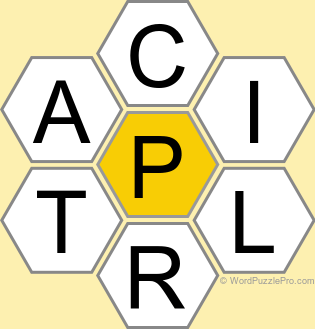
Today's NYT Spelling Bee uses center letter P with outer letters A, C, I, L, R, T. The puzzle contains 50 words worth 210 points, including 1 pangram. The longest word is 9 letters. To reach Genius you need 147 points; Queen Bee requires all 210 points. Today is not a bingo — at least one letter starts no words. Compared with the eight-year average of about 184 points per puzzle, this is a larger-than-average day.
Game Summary

| Center Letter | P |
|---|---|
| Outer Letters | a, c, i, l, r, t |
| # of Pangrams | 1 (Perfect: none) |
| Total Words | 50 words |
| Total Points | 210 points |
| Genius Level | 147 points |
| Bingo? | No |
Table of Contents
As you scroll down this page, the clues get progressively more revealing. So scroll slowly!
- Spelling Bee Grid
- Two-Letter List (2LL) Hints
- Three-Letter List (3LL) Hints
- Extra Letter Hints (Incrementally Revealing) 🤯
- Today's Complete Solution
- Answer Definitions
If you're just here for a list of NYT Spelling Bee answers, Jump down to the answers ↓ (Spoiler Alert!).
Spelling Bee Grid
The following table shows the standard Spelling Bee summary grid, which lists word lengths across the top and letters down the left-hand side. The cell where the word lengths and letters intersect displays the number of words in today's puzzle with the corresponding first letter and word length.
| 4 | 5 | 6 | 7 | 8 | 9 | Σ | |
|---|---|---|---|---|---|---|---|
| A | - | 1 | 2 | 1 | - | - | 4 |
| C | 4 | 2 | 1 | 2 | 1 | - | 10 |
| I | - | - | - | - | - | - | - |
| L | - | - | - | - | - | - | - |
| P | 12 | 3 | 2 | 8 | 1 | 1 | 27 |
| R | 1 | - | - | 1 | - | - | 2 |
| T | 5 | 1 | - | 1 | - | - | 7 | Σ | 22 | 7 | 5 | 13 | 2 | 1 | 50 |
Two-Letter List (2LL) Hints
The following list shows the number of solution words that begin with the corresponding two letters.
| A | AL×1 AP×3 |
|---|---|
| C | CA×6 CL×3 CR×1 |
| I | |
| L | |
| P | PA×14 PI×8 PL×2 PR×3 |
| R | RA×2 |
| T | TA×3 TI×2 TR×2 |
Three-Letter List (3LL) Hints
The following list shows the number of solution words that begin with the corresponding three letters.
| A | ALP×1 APA×1 APP×2 |
|---|---|
| C | CAP×2 CAR×3 CAT×1 CLA×2 CLI×1 CRA×1 |
| I | |
| L | |
| P | PAC×1 PAI×2 PAL×5 PAP×3 PAR×3 PIC×2 PIL×2 PIP×1 PIR×1 PIT×2 PLA×2 PRA×2 PRI×1 |
| R | RAP×1 RAT×1 |
| T | TAP×2 TAR×1 TIL×1 TIP×1 TRA×1 TRI×1 |
Extra Letter Hints (Incrementally Revealing)
The table below lists all of the solutions to today's puzzle, but they're concealed. You can click the plus button (+) to reveal additional letters, one-by-one.
Concealed definitions are provided as additional clues. You can toggle concealment of the definitions by clicking on the concealer bar or the text that appears when the definition is visible.
Pangrams are marked with a dagger symbol (†).
| Word | 2L Ref | Definition (click to reveal) |
|---|---|---|
| pr....... † | PR9 | Relating to, or based on, practice or action rather than theory or hypothesis. |
| al.... | AL6 | A sheep-like animal of the Andes, Vicugna pacos, in the camel family, closely related to the llama, guanaco, and vicuña. |
| ap... | AP5 | Placed separately (in regard to space or time). |
| ap.... | AP6 | To fill with horror; to dismay. |
| ap..... | AP7 | The Soviet machinery of state bureaucratic administration, or a similar communistic structure. |
| ca..... | CA7 | Already-produced durable goods available for use as a factor of production, such as steam shovels (equipment) and office buildings (structures). |
| ca... | CA5 | No definition found; request failed |
| ca.. | CA4 | Any of various freshwater fish of the family Cyprinidae, especially the common carp, Cyprinus carpio. |
| ca.... | CA6 | Any of the eight bones of the wrist (carpus). |
| ca... | CA5 | plural of carpus |
| ca..... | CA7 | Any tree of the genus Catalpa, in the family Bignoniaceae. The two North American species, the southern catalpa, Catalpa bignonioides, and the northern catalpa, Catalpa speciosa — along with the yellow catalpa, Catalpa ovata, from China — are often planted as ornamentals because of their showy flowers and decorative bean pods, though others regard the bean pods as a nuisance. |
| cl.. | CL4 | The act of striking the palms of the hands, or any two surfaces, together. |
| cl...... | CL8 | Empty verbiage or nonsense. |
| cl.. | CL4 | To grip tightly. |
| cr.. | CR4 | The husk of grain; chaff. |
| pa.. | PA4 | An agreement; a compact; a covenant. |
| pa.. | PA4 | A vessel of wood, tin, plastic, etc., usually cylindrical and having a handle -- used especially for carrying liquids, for example water or milk; a bucket (sometimes with a cover). |
| pa.. | PA4 | Two similar or identical things taken together; often followed by of. |
| pa.... | PA6 | An open-sided dwelling with a thatched roof made of dried palm leaves. |
| pa..... | PA7 | Pertaining to the palate. |
| pa...... | PA8 | Of or relating to a palace. |
| pa.. | PA4 | Senses relating to cloth. Fine cloth, especially purple cloth used for robes. A heavy cloth laid over a coffin or tomb; a shroud laid over a corpse. A piece of cardboard, covered with linen and embroidered on one side, used to cover the chalice during the Eucharist. A cloth used for various purposes on the altar in a church, such as a corporal (“cloth on which elements of the Eucharist are placed”) or frontal (“drapery covering the front of an altar”). |
| pa.. | PA4 | Synonym of pedipalp. |
| pa.. | PA4 | Dad, daddy, father; a familiar or old-fashioned term of address to one’s father. |
| pa... | PA5 | Having to do with the pope or the papacy. |
| pa..... | PA7 | A nipple-like protuberance on a part or organ of the body. A vascular process of connective tissue extending into and nourishing the root of a hair, feather, or developing tooth. Any of the vascular protuberances of the dermal layer of the skin extending into the epidermal layer and often containing tactile corpuscles. Any of the small protuberances on the upper surface of the tongue often containing taste buds. |
| pa.. | PA4 | A portion; a component. A fraction of a whole. |
| pa..... | PA7 | existing as a part or portion; incomplete |
| pa..... | PA7 | A type of instrumental suite popular in the 18th century |
| pi.. | PI4 | A disorder characterized by appetite and craving for non-edible substances, such as chalk, clay, dirt, ice, or sand. |
| pi..... | PI7 | Sliced, sautéed and served with lemon, parsley and butter sauce. |
| pi.. | PI4 | A small, usually round or cylindrical object designed for easy swallowing, usually containing some sort of medication. |
| pi.... | PI6 | A large post, often used as supporting architecture. |
| pi... | PI5 | Any of various small passerine birds, mainly from the genus Anthus, that are often drab, ground feeding insectivores of open country. |
| pi..... | PI7 | Alternative form of piratical |
| pi.. | PI4 | A flat bread pouch used for making sandwiches such as gyros or falafels. |
| pi..... | PI7 | Alternative spelling of pit-a-pat |
| pl... | PL5 | A flat fold; a doubling, as of cloth; a pleat. |
| pl.. | PL4 | A plot of land; a lot. |
| pr.. | PR4 | A cunning or mischievous trick; a prank, a joke. |
| pr..... | PR7 | Phallic. |
| ra.. | RA4 | Snatched, taken away; abducted. |
| ra..... | RA7 | A device (trap) used to catch rats. |
| ta.. | TA4 | A kind of cloth prepared by the Polynesians from the inner bark of the paper mulberry. |
| ta... | TA5 | Any one of the species of large odd-toed ungulates of the taxonomic family Tapiridae with a long prehensile upper lip, of which all four surviving species are in genus Tapirus. |
| ta.. | TA4 | A tarpaulin. |
| ti..... | TI7 | Any of various edible fish, formerly species of the genus Tilapia, but now placed in other cichlid genera (such as Oreochromis), native to Africa and the Middle East but cultivated worldwide. |
| ti.. | TI4 | Alternative form of teepee |
| tr.. | TR4 | A machine or other device designed to catch (and sometimes kill) animals, either by holding them in a container, or by catching hold of part of the body. |
| tr.. | TR4 | A journey; an excursion or jaunt. |
Today's Complete Solution
The words that follow are a complete listing of all acceptable words in today's New York Time Spelling Bee puzzle.
Next to the answer word you'll see the two-letter reference (2L Ref) in parentheses. We added that 2L Ref for easier translation of the spoiler-avoidant language you see on the Spelling Bee Forum and Twitter. The 2L Ref signifies a word's two start letters followed by the total number of letters in the word.
- practical† (PR9)
- alpaca (AL6)
- apart (AP5)
- appall (AP6)
- apparat (AP7)
- capital (CA7)
- capri (CA5)
- carp (CA4)
- carpal (CA6)
- carpi (CA5)
- catalpa (CA7)
- clap (CL4)
- claptrap (CL8)
- clip (CL4)
- crap (CR4)
- pact (PA4)
- pail (PA4)
- pair (PA4)
- palapa (PA6)
- palatal (PA7)
- palatial (PA8)
- pall (PA4)
- palp (PA4)
- papa (PA4)
- papal (PA5)
- papilla (PA7)
- part (PA4)
- partial (PA7)
- partita (PA7)
- pica (PI4)
- piccata (PI7)
- pill (PI4)
- pillar (PI6)
- pipit (PI5)
- piratic (PI7)
- pita (PI4)
- pitapat (PI7)
- plait (PL5)
- plat (PL4)
- prat (PR4)
- priapic (PR7)
- rapt (RA4)
- rattrap (RA7)
- tapa (TA4)
- tapir (TA5)
- tarp (TA4)
- tilapia (TI7)
- tipi (TI4)
- trap (TR4)
- trip (TR4)
Answer Definitions
- practical† (adjective): Relating to, or based on, practice or action rather than theory or hypothesis.
- alpaca (noun): A sheep-like animal of the Andes, Vicugna pacos, in the camel family, closely related to the llama, guanaco, and vicuña.
- apart (adverb): Placed separately (in regard to space or time).
- appall (verb): To fill with horror; to dismay.
- apparat (noun): The Soviet machinery of state bureaucratic administration, or a similar communistic structure.
- capital (noun): Already-produced durable goods available for use as a factor of production, such as steam shovels (equipment) and office buildings (structures).
- capri (n/a): No definition found; request failed
- carp (noun): Any of various freshwater fish of the family Cyprinidae, especially the common carp, Cyprinus carpio.
- carpal (noun): Any of the eight bones of the wrist (carpus).
- carpi (noun): plural of carpus
- catalpa (noun): Any tree of the genus Catalpa, in the family Bignoniaceae. The two North American species, the southern catalpa, Catalpa bignonioides, and the northern catalpa, Catalpa speciosa — along with the yellow catalpa, Catalpa ovata, from China — are often planted as ornamentals because of their showy flowers and decorative bean pods, though others regard the bean pods as a nuisance.
- clap (noun): The act of striking the palms of the hands, or any two surfaces, together.
- claptrap (noun): Empty verbiage or nonsense.
- clip (verb): To grip tightly.
- crap (noun): The husk of grain; chaff.
- pact (noun): An agreement; a compact; a covenant.
- pail (noun): A vessel of wood, tin, plastic, etc., usually cylindrical and having a handle -- used especially for carrying liquids, for example water or milk; a bucket (sometimes with a cover).
- pair (noun): Two similar or identical things taken together; often followed by of.
- palapa (noun): An open-sided dwelling with a thatched roof made of dried palm leaves.
- palatal (adjective): Pertaining to the palate.
- palatial (adjective): Of or relating to a palace.
- pall (noun): Senses relating to cloth. Fine cloth, especially purple cloth used for robes. A heavy cloth laid over a coffin or tomb; a shroud laid over a corpse. A piece of cardboard, covered with linen and embroidered on one side, used to cover the chalice during the Eucharist. A cloth used for various purposes on the altar in a church, such as a corporal (“cloth on which elements of the Eucharist are placed”) or frontal (“drapery covering the front of an altar”).
- palp (noun): Synonym of pedipalp.
- papa (noun): Dad, daddy, father; a familiar or old-fashioned term of address to one’s father.
- papal (adjective): Having to do with the pope or the papacy.
- papilla (noun): A nipple-like protuberance on a part or organ of the body. A vascular process of connective tissue extending into and nourishing the root of a hair, feather, or developing tooth. Any of the vascular protuberances of the dermal layer of the skin extending into the epidermal layer and often containing tactile corpuscles. Any of the small protuberances on the upper surface of the tongue often containing taste buds.
- part (noun): A portion; a component. A fraction of a whole.
- partial (adjective): existing as a part or portion; incomplete
- partita (noun): A type of instrumental suite popular in the 18th century
- pica (noun): A disorder characterized by appetite and craving for non-edible substances, such as chalk, clay, dirt, ice, or sand.
- piccata (adjective): Sliced, sautéed and served with lemon, parsley and butter sauce.
- pill (noun): A small, usually round or cylindrical object designed for easy swallowing, usually containing some sort of medication.
- pillar (noun): A large post, often used as supporting architecture.
- pipit (noun): Any of various small passerine birds, mainly from the genus Anthus, that are often drab, ground feeding insectivores of open country.
- piratic (adjective): Alternative form of piratical
- pita (noun): A flat bread pouch used for making sandwiches such as gyros or falafels.
- pitapat (verb): Alternative spelling of pit-a-pat
- plait (noun): A flat fold; a doubling, as of cloth; a pleat.
- plat (noun): A plot of land; a lot.
- prat (noun): A cunning or mischievous trick; a prank, a joke.
- priapic (adjective): Phallic.
- rapt (adjective): Snatched, taken away; abducted.
- rattrap (noun): A device (trap) used to catch rats.
- tapa (noun): A kind of cloth prepared by the Polynesians from the inner bark of the paper mulberry.
- tapir (noun): Any one of the species of large odd-toed ungulates of the taxonomic family Tapiridae with a long prehensile upper lip, of which all four surviving species are in genus Tapirus.
- tarp (noun): A tarpaulin.
- tilapia (noun): Any of various edible fish, formerly species of the genus Tilapia, but now placed in other cichlid genera (such as Oreochromis), native to Africa and the Middle East but cultivated worldwide.
- tipi (noun): Alternative form of teepee
- trap (noun): A machine or other device designed to catch (and sometimes kill) animals, either by holding them in a container, or by catching hold of part of the body.
- trip (noun): A journey; an excursion or jaunt.