NYT Spelling Bee Answers for October 17, 2026
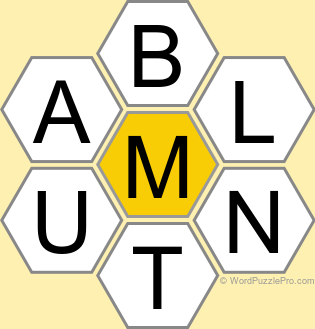
Today's NYT Spelling Bee uses center letter M with outer letters A, B, L, N, T, U. The puzzle contains 33 words worth 144 points, including 1 pangram. The longest word is 8 letters. To reach Genius you need 101 points; Queen Bee requires all 144 points. Today is a bingo — every letter starts at least one word. Compared with the eight-year average of about 184 points per puzzle, this is a smaller-than-average day.
Game Summary

| Center Letter | M |
|---|---|
| Outer Letters | a, b, l, n, t, u |
| # of Pangrams | 1 (Perfect: none) |
| Total Words | 33 words |
| Total Points | 144 points |
| Genius Level | 101 points |
| Bingo? | Yes |
Table of Contents
As you scroll down this page, the clues get progressively more revealing. So scroll slowly!
- Spelling Bee Grid
- Two-Letter List (2LL) Hints
- Three-Letter List (3LL) Hints
- Extra Letter Hints (Incrementally Revealing) 🤯
- Today's Complete Solution
- Answer Definitions
If you're just here for a list of NYT Spelling Bee answers, Jump down to the answers ↓ (Spoiler Alert!).
Spelling Bee Grid
The following table shows the standard Spelling Bee summary grid, which lists word lengths across the top and letters down the left-hand side. The cell where the word lengths and letters intersect displays the number of words in today's puzzle with the corresponding first letter and word length.
| 4 | 5 | 6 | 7 | 8 | Σ | |
|---|---|---|---|---|---|---|
| A | 1 | 1 | 2 | - | 2 | 6 |
| B | 2 | - | 1 | - | - | 3 |
| L | 2 | 1 | - | - | - | 3 |
| M | 6 | 4 | 5 | - | - | 15 |
| N | 1 | - | 1 | - | - | 2 |
| T | - | - | 1 | - | 1 | 2 |
| U | - | 1 | 1 | - | - | 2 | Σ | 12 | 7 | 11 | - | 3 | 33 |
Two-Letter List (2LL) Hints
The following list shows the number of solution words that begin with the corresponding two letters.
| A | AL×3 AM×1 AU×2 |
|---|---|
| B | BA×2 BL×1 |
| L | LA×2 LL×1 |
| M | MA×10 MU×5 |
| N | NU×2 |
| T | TA×1 TU×1 |
| U | UM×1 UN×1 |
Three-Letter List (3LL) Hints
The following list shows the number of solution words that begin with the corresponding three letters.
| A | ALB×1 ALU×2 AMB×1 AUT×2 |
|---|---|
| B | BAL×1 BAN×1 BLA×1 |
| L | LAM×2 LLA×1 |
| M | MAL×2 MAM×4 MAN×3 MAU×1 MUL×1 MUT×3 MUU×1 |
| N | NUM×2 |
| T | TAN×1 TUM×1 |
| U | UML×1 UNM×1 |
Extra Letter Hints (Incrementally Revealing)
The table below lists all of the solutions to today's puzzle, but they're concealed. You can click the plus button (+) to reveal additional letters, one-by-one.
Concealed definitions are provided as additional clues. You can toggle concealment of the definitions by clicking on the concealer bar or the text that appears when the definition is visible.
Pangrams are marked with a dagger symbol (†).
| Word | 2L Ref | Definition (click to reveal) |
|---|---|---|
| am...... † | AM8 | Able to walk. |
| al... | AL5 | In Ancient Rome, a white tablet or register on which the praetor's edicts and other public notices were recorded. |
| al.. | AL4 | An astringent salt, usually occurring in the form of pale crystals, much used in the dyeing and tanning trade and in certain medicines, and now understood to be a double sulphate of potassium and aluminium (K2SO4·Al2(SO4)3·24H2O). |
| al.... | AL6 | A female pupil or student (especially of a university or college). |
| au.... | AU6 | Traditionally the third of the four seasons, when deciduous trees lose their leaves; typically regarded as being from September 24 to December 22 in parts of the Northern Hemisphere, and the months of March, April and May in the Southern Hemisphere. |
| au...... | AU8 | Of or relating to autumn. |
| ba.. | BA4 | Any of various aromatic resins exuded from certain plants, especially trees of the genus Commiphora of Africa, Arabia and India and Myroxylon of South America. |
| ba.... | BA6 | Any of several small chickens, especially of a breed that is a miniature version of another breed. |
| bl.. | BL4 | A sudden, explosive sound, such as is made by a gunshot |
| la.. | LA4 | A master of Tibetan Buddhism. |
| la.. | LA4 | A young sheep. |
| ll... | LL5 | A South American mammal of the camel family, Lama glama, used as a domestic beast of burden and a source of wool and meat. |
| ma.. | MA4 | A pedestrianised street, especially a shopping precinct. |
| ma.. | MA4 | Malted grain (sprouted grain) (usually barley), used in brewing and otherwise. |
| ma.. | MA4 | Mother, female parent. |
| ma... | MA5 | Any of various venomous snakes of the genus Dendroaspis, native to Africa, that live in trees. |
| ma... | MA5 | The milk-secreting organ of female humans and other mammals which includes the mammary gland and the nipple or teat; a breast; an udder. |
| ma.... | MA6 | An animal of the class Mammalia, characterized by being warm-blooded, having hair and producing milk with which to feed its young. |
| ma... | MA5 | Food miraculously produced for the Israelites in the desert in the book of Exodus. |
| ma... | MA5 | A kind of fabric or blanket used in Latin America and southwestern United States. |
| ma.... | MA6 | A handbook. |
| ma.. | MA4 | A heavy long-handled hammer, used for splitting logs by driving a wedge into them, or in combat. |
| mu.. | MU4 | (usually with over) To work (over) mentally; to cogitate; to ruminate. |
| mu.... | MU6 | That has mutated, with one or more new characteristics from a mutation. |
| mu.. | MU4 | A mongrel dog (or sometimes cat); an animal of mixed breed or uncertain origin. |
| mu.... | MU6 | Having the same relationship, each to each other. |
| mu.... | MU6 | A long loose-fitting dress made of lightweight fabric printed with bright, stylized Hawaiian themes (such as flowers and palm branches). |
| nu.. | NU4 | Physically unable to feel, not having the power of sensation. |
| nu.... | NU6 | A small marsupial carnivore, Myrmecobius fasciatus, endemic to western Australia, that eats almost exclusively termites. |
| ta...... | TA8 | A chemical element (symbol Ta) with atomic number 73: a rare, hard, blue-gray, lustrous transition metal that is highly corrosion-resistant. |
| tu.... | TU6 | Confused, agitated noise as made by a crowd. |
| um.... | UM6 | An assimilatory process whereby a vowel is pronounced more like a following vocoid that is separated by one or more consonants. |
| un... | UN5 | To castrate; to remove the manhood of. |
Today's Complete Solution
The words that follow are a complete listing of all acceptable words in today's New York Time Spelling Bee puzzle.
Next to the answer word you'll see the two-letter reference (2L Ref) in parentheses. We added that 2L Ref for easier translation of the spoiler-avoidant language you see on the Spelling Bee Forum and Twitter. The 2L Ref signifies a word's two start letters followed by the total number of letters in the word.
- ambulant† (AM8)
- album (AL5)
- alum (AL4)
- alumna (AL6)
- autumn (AU6)
- autumnal (AU8)
- balm (BA4)
- bantam (BA6)
- blam (BL4)
- lama (LA4)
- lamb (LA4)
- llama (LL5)
- mall (MA4)
- malt (MA4)
- mama (MA4)
- mamba (MA5)
- mamma (MA5)
- mammal (MA6)
- manna (MA5)
- manta (MA5)
- manual (MA6)
- maul (MA4)
- mull (MU4)
- mutant (MU6)
- mutt (MU4)
- mutual (MU6)
- muumuu (MU6)
- numb (NU4)
- numbat (NU6)
- tantalum (TA8)
- tumult (TU6)
- umlaut (UM6)
- unman (UN5)
Answer Definitions
- ambulant† (adjective): Able to walk.
- album (noun): In Ancient Rome, a white tablet or register on which the praetor's edicts and other public notices were recorded.
- alum (noun): An astringent salt, usually occurring in the form of pale crystals, much used in the dyeing and tanning trade and in certain medicines, and now understood to be a double sulphate of potassium and aluminium (K2SO4·Al2(SO4)3·24H2O).
- alumna (noun): A female pupil or student (especially of a university or college).
- autumn (noun): Traditionally the third of the four seasons, when deciduous trees lose their leaves; typically regarded as being from September 24 to December 22 in parts of the Northern Hemisphere, and the months of March, April and May in the Southern Hemisphere.
- autumnal (adjective): Of or relating to autumn.
- balm (noun): Any of various aromatic resins exuded from certain plants, especially trees of the genus Commiphora of Africa, Arabia and India and Myroxylon of South America.
- bantam (noun): Any of several small chickens, especially of a breed that is a miniature version of another breed.
- blam (noun): A sudden, explosive sound, such as is made by a gunshot
- lama (noun): A master of Tibetan Buddhism.
- lamb (noun): A young sheep.
- llama (noun): A South American mammal of the camel family, Lama glama, used as a domestic beast of burden and a source of wool and meat.
- mall (noun): A pedestrianised street, especially a shopping precinct.
- malt (noun): Malted grain (sprouted grain) (usually barley), used in brewing and otherwise.
- mama (noun): Mother, female parent.
- mamba (noun): Any of various venomous snakes of the genus Dendroaspis, native to Africa, that live in trees.
- mamma (noun): The milk-secreting organ of female humans and other mammals which includes the mammary gland and the nipple or teat; a breast; an udder.
- mammal (noun): An animal of the class Mammalia, characterized by being warm-blooded, having hair and producing milk with which to feed its young.
- manna (noun): Food miraculously produced for the Israelites in the desert in the book of Exodus.
- manta (noun): A kind of fabric or blanket used in Latin America and southwestern United States.
- manual (noun): A handbook.
- maul (noun): A heavy long-handled hammer, used for splitting logs by driving a wedge into them, or in combat.
- mull (verb): (usually with over) To work (over) mentally; to cogitate; to ruminate.
- mutant (noun): That has mutated, with one or more new characteristics from a mutation.
- mutt (noun): A mongrel dog (or sometimes cat); an animal of mixed breed or uncertain origin.
- mutual (adjective): Having the same relationship, each to each other.
- muumuu (noun): A long loose-fitting dress made of lightweight fabric printed with bright, stylized Hawaiian themes (such as flowers and palm branches).
- numb (adjective): Physically unable to feel, not having the power of sensation.
- numbat (noun): A small marsupial carnivore, Myrmecobius fasciatus, endemic to western Australia, that eats almost exclusively termites.
- tantalum (noun): A chemical element (symbol Ta) with atomic number 73: a rare, hard, blue-gray, lustrous transition metal that is highly corrosion-resistant.
- tumult (noun): Confused, agitated noise as made by a crowd.
- umlaut (noun): An assimilatory process whereby a vowel is pronounced more like a following vocoid that is separated by one or more consonants.
- unman (verb): To castrate; to remove the manhood of.