NYT Spelling Bee Answers for May 5, 2026
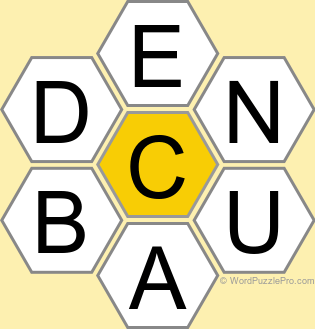
Today's NYT Spelling Bee uses center letter C with outer letters D, E, N, U, A, B. The puzzle contains 34 words worth 180 points, including 1 pangram. The longest word is 9 letters. To reach Genius you need 126 points; Queen Bee requires all 180 points. Today is a bingo — every letter starts at least one word. Compared with the eight-year average of about 183 points per puzzle, this is a smaller-than-average day.
Game Summary

| Center Letter | C |
|---|---|
| Outer Letters | d, e, n, u, a, b |
| # of Pangrams | 1 (Perfect: none) |
| Total Words | 34 words |
| Total Points | 180 points |
| Genius Level | 126 points |
| Bingo? | Yes |
Table of Contents
As you scroll down this page, the clues get progressively more revealing. So scroll slowly!
- Spelling Bee Grid
- Two-Letter List (2LL) Hints
- Three-Letter List (3LL) Hints
- Extra Letter Hints (Incrementally Revealing) 🤯
- Today's Complete Solution
- Answer Definitions
If you're just here for a list of NYT Spelling Bee answers, Jump down to the answers ↓ (Spoiler Alert!).
Spelling Bee Grid
The following table shows the standard Spelling Bee summary grid, which lists word lengths across the top and letters down the left-hand side. The cell where the word lengths and letters intersect displays the number of words in today's puzzle with the corresponding first letter and word length.
| 4 | 5 | 6 | 7 | 8 | 9 | Σ | |
|---|---|---|---|---|---|---|---|
| A | 2 | - | 2 | 2 | - | 1 | 7 |
| B | 1 | - | - | - | - | - | 1 |
| C | 4 | 4 | 4 | 1 | - | - | 13 |
| D | - | 3 | 3 | 1 | - | 1 | 8 |
| E | - | 1 | 1 | - | - | - | 2 |
| N | - | - | 1 | 1 | - | - | 2 |
| U | - | - | - | 1 | - | - | 1 | Σ | 7 | 8 | 11 | 6 | - | 2 | 34 |
Two-Letter List (2LL) Hints
The following list shows the number of solution words that begin with the corresponding two letters.
| A | AB×1 AC×4 AD×2 |
|---|---|
| B | BA×1 |
| C | CA×8 CE×2 CU×3 |
| D | DA×2 DE×5 DU×1 |
| E | ED×2 |
| N | NU×2 |
| U | UN×1 |
Three-Letter List (3LL) Hints
The following list shows the number of solution words that begin with the corresponding three letters.
| A | ABU×1 ACC×2 ACE×1 ACN×1 ADD×2 |
|---|---|
| B | BAN×1 |
| C | CAB×2 CAD×1 CAN×5 CED×2 CUB×2 CUE×1 |
| D | DAN×2 DEC×2 DED×2 DEU×1 DUN×1 |
| E | EDU×2 |
| N | NUA×2 |
| U | UNC×1 |
Extra Letter Hints (Incrementally Revealing)
The table below lists all of the solutions to today's puzzle, but they're concealed. You can click the plus button (+) to reveal additional letters, one-by-one.
Concealed definitions are provided as additional clues. You can toggle concealment of the definitions by clicking on the concealer bar or the text that appears when the definition is visible.
Pangrams are marked with a dagger symbol (†).
| Word | 2L Ref | Definition (click to reveal) |
|---|---|---|
| ab....... † | AB9 | A large quantity; many. |
| ac.... | AC6 | To approach; to arrive, to come forward. |
| ac..... | AC7 | simple past tense and past participle of accede |
| ac.. | AC4 | simple past tense and past participle of ace |
| ac.. | AC4 | A skin condition, usually of the face, that is common in adolescents. It is characterised by red pimples, and is caused by the inflammation of sebaceous glands through bacterial infection. |
| ad.... | AD6 | To bring forward or offer, as an argument, passage, or consideration which bears on a statement or case; to cite; to allege. |
| ad..... | AD7 | simple past and past participle of adduce |
| ba.. | BA4 | A bench; a high seat, or seat of distinction or judgment. |
| ca.... | CA6 | A cabin or hut for relaxing. |
| ca.... | CA6 | simple past tense and past participle of cab |
| ca..... | CA7 | The act or state of declining or sinking. |
| ca.... | CA6 | A high-kicking chorus line dance originating in France. |
| ca.. | CA4 | A plant with simple stems, like bamboo or sugar cane, or the stem thereof The slender, flexible main stem of a plant such as bamboo, including many species in the grass family Gramineae |
| ca... | CA5 | simple past tense and past participle of cane |
| ca... | CA5 | Any member of the genus Canna of tropical plants with large leaves and often showy flowers. |
| ca.... | CA6 | Preserved in cans. |
| ce.. | CE4 | To give up; yield to another. |
| ce... | CE5 | simple past tense and past participle of cede |
| cu.. | CU4 | A regular polyhedron having six identical square faces. |
| cu... | CU5 | simple past and past participle of cube |
| cu.. | CU4 | simple past tense and past participle of cue |
| da... | DA5 | A sequence of rhythmic steps or movements usually performed to music, for pleasure or as a form of social interaction. |
| da.... | DA6 | simple past tense and past participle of dance |
| de.... | DE6 | A group, set, or series of ten , particularly: |
| de....... | DE9 | A state of moral or artistic decline or deterioration; decay |
| de.... | DE6 | To reach (a conclusion) by applying rules of logic or other forms of reasoning to given premises or known facts. |
| de..... | DE7 | simple past tense and past participle of deduce |
| de... | DE5 | A card with two pips, one of four in a standard deck of playing cards. |
| du... | DU5 | An unintelligent person. |
| ed... | ED5 | To direct the course of (a flow, journey etc.); to lead in a particular direction. |
| ed.... | ED6 | simple past tense and past participle of educe |
| nu.... | NU6 | A minor distinction. |
| nu..... | NU7 | No definition found; request failed |
| un..... | UN7 | Not having been ceded. |
Today's Complete Solution
The words that follow are a complete listing of all acceptable words in today's New York Time Spelling Bee puzzle.
Next to the answer word you'll see the two-letter reference (2L Ref) in parentheses. We added that 2L Ref for easier translation of the spoiler-avoidant language you see on the Spelling Bee Forum and Twitter. The 2L Ref signifies a word's two start letters followed by the total number of letters in the word.
- abundance† (AB9)
- accede (AC6)
- acceded (AC7)
- aced (AC4)
- acne (AC4)
- adduce (AD6)
- adduced (AD7)
- banc (BA4)
- cabana (CA6)
- cabbed (CA6)
- cadence (CA7)
- cancan (CA6)
- cane (CA4)
- caned (CA5)
- canna (CA5)
- canned (CA6)
- cede (CE4)
- ceded (CE5)
- cube (CU4)
- cubed (CU5)
- cued (CU4)
- dance (DA5)
- danced (DA6)
- decade (DE6)
- decadence (DE9)
- deduce (DE6)
- deduced (DE7)
- deuce (DE5)
- dunce (DU5)
- educe (ED5)
- educed (ED6)
- nuance (NU6)
- nuanced (NU7)
- unceded (UN7)
Answer Definitions
- abundance† (noun): A large quantity; many.
- accede (verb): To approach; to arrive, to come forward.
- acceded (verb): simple past tense and past participle of accede
- aced (verb): simple past tense and past participle of ace
- acne (noun): A skin condition, usually of the face, that is common in adolescents. It is characterised by red pimples, and is caused by the inflammation of sebaceous glands through bacterial infection.
- adduce (verb): To bring forward or offer, as an argument, passage, or consideration which bears on a statement or case; to cite; to allege.
- adduced (verb): simple past and past participle of adduce
- banc (noun): A bench; a high seat, or seat of distinction or judgment.
- cabana (noun): A cabin or hut for relaxing.
- cabbed (verb): simple past tense and past participle of cab
- cadence (noun): The act or state of declining or sinking.
- cancan (noun): A high-kicking chorus line dance originating in France.
- cane (noun): A plant with simple stems, like bamboo or sugar cane, or the stem thereof The slender, flexible main stem of a plant such as bamboo, including many species in the grass family Gramineae
- caned (verb): simple past tense and past participle of cane
- canna (noun): Any member of the genus Canna of tropical plants with large leaves and often showy flowers.
- canned (adjective): Preserved in cans.
- cede (verb): To give up; yield to another.
- ceded (verb): simple past tense and past participle of cede
- cube (noun): A regular polyhedron having six identical square faces.
- cubed (verb): simple past and past participle of cube
- cued (verb): simple past tense and past participle of cue
- dance (noun): A sequence of rhythmic steps or movements usually performed to music, for pleasure or as a form of social interaction.
- danced (verb): simple past tense and past participle of dance
- decade (noun): A group, set, or series of ten , particularly:
- decadence (noun): A state of moral or artistic decline or deterioration; decay
- deduce (verb): To reach (a conclusion) by applying rules of logic or other forms of reasoning to given premises or known facts.
- deduced (verb): simple past tense and past participle of deduce
- deuce (noun): A card with two pips, one of four in a standard deck of playing cards.
- dunce (noun): An unintelligent person.
- educe (verb): To direct the course of (a flow, journey etc.); to lead in a particular direction.
- educed (verb): simple past tense and past participle of educe
- nuance (noun): A minor distinction.
- nuanced (n/a): No definition found; request failed
- unceded (adjective): Not having been ceded.