NYT Spelling Bee Answers for April 15, 2026
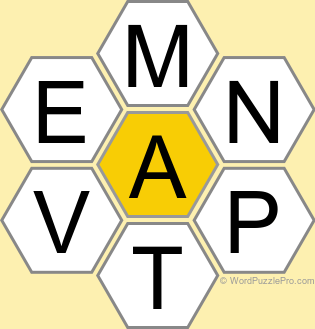
Today's NYT Spelling Bee uses center letter A with outer letters E, M, N, P, T, V. The puzzle contains 62 words worth 229 points, including 1 pangram. The longest word is 8 letters. To reach Genius you need 160 points; Queen Bee requires all 229 points. Today is a bingo — every letter starts at least one word. Compared with the eight-year average of about 184 points per puzzle, this is a larger-than-average day.
Game Summary

| Center Letter | A |
|---|---|
| Outer Letters | e, m, n, p, t, v |
| # of Pangrams | 1 (Perfect: none) |
| Total Words | 62 words |
| Total Points | 229 points |
| Genius Level | 160 points |
| Bingo? | Yes |
Table of Contents
As you scroll down this page, the clues get progressively more revealing. So scroll slowly!
- Spelling Bee Grid
- Two-Letter List (2LL) Hints
- Three-Letter List (3LL) Hints
- Extra Letter Hints (Incrementally Revealing) 🤯
- Today's Complete Solution
- Answer Definitions
If you're just here for a list of NYT Spelling Bee answers, Jump down to the answers ↓ (Spoiler Alert!).
Spelling Bee Grid
The following table shows the standard Spelling Bee summary grid, which lists word lengths across the top and letters down the left-hand side. The cell where the word lengths and letters intersect displays the number of words in today's puzzle with the corresponding first letter and word length.
| 4 | 5 | 6 | 7 | 8 | Σ | |
|---|---|---|---|---|---|---|
| A | 2 | 1 | 2 | 2 | 1 | 8 |
| E | 1 | 2 | - | 1 | - | 4 |
| M | 6 | 6 | - | 1 | - | 13 |
| N | 7 | - | 2 | - | 1 | 10 |
| P | 6 | 2 | 4 | 2 | 2 | 16 |
| T | 6 | - | 1 | - | 1 | 8 |
| V | 3 | - | - | - | - | 3 | Σ | 31 | 11 | 9 | 6 | 5 | 62 |
Two-Letter List (2LL) Hints
The following list shows the number of solution words that begin with the corresponding two letters.
| A | AM×1 AN×3 AP×3 AT×1 |
|---|---|
| E | EA×2 EM×1 EN×1 |
| M | MA×9 ME×4 |
| N | NA×7 NE×3 |
| P | PA×12 PE×4 |
| T | TA×4 TE×4 |
| V | VA×3 |
Three-Letter List (3LL) Hints
The following list shows the number of solution words that begin with the corresponding three letters.
| A | AME×1 ANT×3 APE×2 APN×1 ATT×1 |
|---|---|
| E | EAT×1 EAV×1 EMA×1 ENE×1 |
| M | MAM×2 MAN×4 MAT×2 MAV×1 MEA×3 MET×1 |
| N | NAA×1 NAM×2 NAN×1 NAP×1 NAT×1 NAV×1 NEA×3 |
| P | PAE×1 PAM×1 PAN×3 PAP×1 PAT×3 PAV×3 PEA×1 PEN×3 |
| T | TAM×2 TAP×2 TEA×3 TEN×1 |
| V | VAM×1 VAN×1 VAP×1 |
Extra Letter Hints (Incrementally Revealing)
The table below lists all of the solutions to today's puzzle, but they're concealed. You can click the plus button (+) to reveal additional letters, one-by-one.
Concealed definitions are provided as additional clues. You can toggle concealment of the definitions by clicking on the concealer bar or the text that appears when the definition is visible.
Pangrams are marked with a dagger symbol (†).
| Word | 2L Ref | Definition (click to reveal) |
|---|---|---|
| pa...... † | PA8 | A paved surface; a hard covering on the ground. |
| am.. | AM4 | At the end of religious prayers: so be it. |
| an.. | AN4 | A price or cost, as in up the ante. |
| an..... | AN7 | A feeler organ on the head of an insect, crab, or other animal. |
| an...... | AN8 | plural of antenna |
| ap.... | AP6 | A prehistoric man resembling an ape, especially one held to be a precursor to modern humans; a non-human australopithecine. |
| ap.... | AP6 | plural of apeman |
| ap... | AP5 | The cessation of breathing, most often in reference to transient instances thereof during sleep. |
| at..... | AT7 | To try. |
| ea... | EA5 | past participle of eat |
| ea.. | EA4 | Alternative form of eaves (“the underside of a roof that extends beyond the external walls of a building”) |
| em..... | EM7 | To come from a source; issue from. |
| en... | EN5 | An injection of fluid into the large intestine by way of the rectum, usually for medical purposes. |
| ma.. | MA4 | Mother, female parent. |
| ma... | MA5 | The milk-secreting organ of female humans and other mammals which includes the mammary gland and the nipple or teat; a breast; an udder. |
| ma..... | MA7 | Any of several plant-eating marine mammals, of family Trichechidae, found in tropical regions. |
| ma.. | MA4 | Longer hair growth on back of neck of an animal, especially a horse or lion |
| ma... | MA5 | Food miraculously produced for the Israelites in the desert in the book of Exodus. |
| ma... | MA5 | A kind of fabric or blanket used in Latin America and southwestern United States. |
| ma.. | MA4 | A fellow, comrade, colleague, partner or someone with whom something is shared, e.g. shipmate, classmate. |
| ma... | MA5 | A decorative border around a picture used to inset and center the contents of a frame. |
| ma... | MA5 | An expert in a given field. |
| me.. | ME4 | To intend. To intend, to plan (to do); to have as one's intention. |
| me... | ME5 | simple past tense and past participle of mean |
| me.. | ME4 | The flesh (muscle tissue) of an animal used as food. |
| me.. | ME4 | Self-referential; structured analogously (structured by relationships), but at a higher level. |
| na.. | NA4 | A type of round, flat bread baked in a tandoor popular in South and Central Asian cuisine. |
| na.. | NA4 | Any nounal word or phrase which indicates a particular person, place, class, or thing. |
| na...... | NA8 | A kind of nametag that can be sewn onto clothing. |
| na.. | NA4 | A banana. |
| na.. | NA4 | The back part of the neck. |
| na.... | NA6 | floating or swimming (in water) |
| na.. | NA4 | The middle or body of a church, extending from the transepts to the principal entrances. |
| ne.. | NE4 | The tongue or pole of a cart or other vehicle drawn by two animals. |
| ne.. | NE4 | Clean, tidy; free from dirt or impurities. |
| ne.... | NE6 | To make (someone or something) neat; to arrange (people or things) in an orderly, tidy way; to tidy. |
| pa... | PA5 | A chant or song, especially a hymn of thanksgiving for deliverance or victory, to Apollo or sometimes another god or goddess; hence any song sung to solicit victory in battle. |
| pa... | PA5 | singular of pampas |
| pa.... | PA6 | a lightweight hat of natural-colored straw hand-plaited of narrow strips from the young leaves of the jipijapa |
| pa.. | PA4 | An individual sheet of glass in a window, door, etc. |
| pa.. | PA4 | A quick breathing; a catching of the breath; a gasp: the panting of animals such as a dog with their tong hung out- as a form of thermoregulation. |
| pa.. | PA4 | Dad, daddy, father; a familiar or old-fashioned term of address to one’s father. |
| pa.. | PA4 | The head, particularly the top or crown. |
| pa.... | PA6 | An official document granting an appointment, privilege, or right, or some property or title; letters patent. A grant of a monopoly over the manufacture, sale, and use of goods. A declaration issued by a government agency that the inventor of a new invention has the sole privilege of making, selling, or using the claimed invention for a specified period. A specific grant of ownership of a piece of real property; a land patent. |
| pa...... | PA8 | One to whom a grant is made, or a privilege secured, by patent. |
| pa.... | PA6 | A musical style characteristic of the 16th and 17th centuries. |
| pa.. | PA4 | To cover something with paving slabs. |
| pe.. | PE4 | Soil formed of dead but not fully decayed plants found in bog areas, often burned as fuel. |
| pe.... | PE6 | A scribe, or person who copies texts. |
| pe..... | PE7 | A flag normally used by naval vessels to represent a special condition. The broad pennant flown by commodores. The church pennant indicating religious services are taking place aboard ship. The commissioning pennant flown on ceremonial occasions. |
| pe..... | PE7 | An aliphatic hydrocarbon of chemical formula C5H12; either of the three isomers n-pentane, methyl-butane (isopentane), and di-methyl-propane (neopentane); volatile liquids under normal conditions. |
| ta.. | TA4 | Not or no longer wild; domesticated. |
| ta.. | TA4 | To plug up with clay, earth, dry sand, sod, or other material, as a hole bored in a rock. |
| ta.. | TA4 | A kind of cloth prepared by the Polynesians from the inner bark of the paper mulberry. |
| ta.. | TA4 | Flexible material in a roll with a sticky surface on one or both sides; adhesive tape. |
| te.. | TE4 | A set of draught animals, such as two horses in front of a carriage. |
| te...... | TE8 | One who is on the same team. |
| te.. | TE4 | The projection of a mammary gland from which, on female mammals, milk is secreted. |
| te.... | TE6 | One who holds a lease (a tenancy). |
| va.. | VA4 | The top part of a boot or shoe, above the sole and welt and in front of the ankle seam, that covers the instep and toes; the front part of an upper; the analogous part of a stocking. |
| va.. | VA4 | A weather vane. |
| va.. | VA4 | Clipping of vaporizer. |
Today's Complete Solution
The words that follow are a complete listing of all acceptable words in today's New York Time Spelling Bee puzzle.
Next to the answer word you'll see the two-letter reference (2L Ref) in parentheses. We added that 2L Ref for easier translation of the spoiler-avoidant language you see on the Spelling Bee Forum and Twitter. The 2L Ref signifies a word's two start letters followed by the total number of letters in the word.
- pavement† (PA8)
- amen (AM4)
- ante (AN4)
- antenna (AN7)
- antennae (AN8)
- apeman (AP6)
- apemen (AP6)
- apnea (AP5)
- attempt (AT7)
- eaten (EA5)
- eave (EA4)
- emanate (EM7)
- enema (EN5)
- mama (MA4)
- mamma (MA5)
- manatee (MA7)
- mane (MA4)
- manna (MA5)
- manta (MA5)
- mate (MA4)
- matte (MA5)
- maven (MA5)
- mean (ME4)
- meant (ME5)
- meat (ME4)
- meta (ME4)
- naan (NA4)
- name (NA4)
- nametape (NA8)
- nana (NA4)
- nape (NA4)
- natant (NA6)
- nave (NA4)
- neap (NE4)
- neat (NE4)
- neaten (NE6)
- paean (PA5)
- pampa (PA5)
- panama (PA6)
- pane (PA4)
- pant (PA4)
- papa (PA4)
- pate (PA4)
- patent (PA6)
- patentee (PA8)
- pavane (PA6)
- pave (PA4)
- peat (PE4)
- penman (PE6)
- pennant (PE7)
- pentane (PE7)
- tame (TA4)
- tamp (TA4)
- tapa (TA4)
- tape (TA4)
- team (TE4)
- teammate (TE8)
- teat (TE4)
- tenant (TE6)
- vamp (VA4)
- vane (VA4)
- vape (VA4)
Answer Definitions
- pavement† (noun): A paved surface; a hard covering on the ground.
- amen (adverb): At the end of religious prayers: so be it.
- ante (noun): A price or cost, as in up the ante.
- antenna (noun): A feeler organ on the head of an insect, crab, or other animal.
- antennae (noun): plural of antenna
- apeman (noun): A prehistoric man resembling an ape, especially one held to be a precursor to modern humans; a non-human australopithecine.
- apemen (noun): plural of apeman
- apnea (noun): The cessation of breathing, most often in reference to transient instances thereof during sleep.
- attempt (verb): To try.
- eaten (verb): past participle of eat
- eave (noun): Alternative form of eaves (“the underside of a roof that extends beyond the external walls of a building”)
- emanate (verb): To come from a source; issue from.
- enema (noun): An injection of fluid into the large intestine by way of the rectum, usually for medical purposes.
- mama (noun): Mother, female parent.
- mamma (noun): The milk-secreting organ of female humans and other mammals which includes the mammary gland and the nipple or teat; a breast; an udder.
- manatee (noun): Any of several plant-eating marine mammals, of family Trichechidae, found in tropical regions.
- mane (noun): Longer hair growth on back of neck of an animal, especially a horse or lion
- manna (noun): Food miraculously produced for the Israelites in the desert in the book of Exodus.
- manta (noun): A kind of fabric or blanket used in Latin America and southwestern United States.
- mate (noun): A fellow, comrade, colleague, partner or someone with whom something is shared, e.g. shipmate, classmate.
- matte (noun): A decorative border around a picture used to inset and center the contents of a frame.
- maven (noun): An expert in a given field.
- mean (verb): To intend. To intend, to plan (to do); to have as one's intention.
- meant (verb): simple past tense and past participle of mean
- meat (noun): The flesh (muscle tissue) of an animal used as food.
- meta (adjective): Self-referential; structured analogously (structured by relationships), but at a higher level.
- naan (noun): A type of round, flat bread baked in a tandoor popular in South and Central Asian cuisine.
- name (noun): Any nounal word or phrase which indicates a particular person, place, class, or thing.
- nametape (noun): A kind of nametag that can be sewn onto clothing.
- nana (noun): A banana.
- nape (noun): The back part of the neck.
- natant (adjective): floating or swimming (in water)
- nave (noun): The middle or body of a church, extending from the transepts to the principal entrances.
- neap (noun): The tongue or pole of a cart or other vehicle drawn by two animals.
- neat (adjective): Clean, tidy; free from dirt or impurities.
- neaten (verb): To make (someone or something) neat; to arrange (people or things) in an orderly, tidy way; to tidy.
- paean (noun): A chant or song, especially a hymn of thanksgiving for deliverance or victory, to Apollo or sometimes another god or goddess; hence any song sung to solicit victory in battle.
- pampa (noun): singular of pampas
- panama (noun): a lightweight hat of natural-colored straw hand-plaited of narrow strips from the young leaves of the jipijapa
- pane (noun): An individual sheet of glass in a window, door, etc.
- pant (noun): A quick breathing; a catching of the breath; a gasp: the panting of animals such as a dog with their tong hung out- as a form of thermoregulation.
- papa (noun): Dad, daddy, father; a familiar or old-fashioned term of address to one’s father.
- pate (noun): The head, particularly the top or crown.
- patent (noun): An official document granting an appointment, privilege, or right, or some property or title; letters patent. A grant of a monopoly over the manufacture, sale, and use of goods. A declaration issued by a government agency that the inventor of a new invention has the sole privilege of making, selling, or using the claimed invention for a specified period. A specific grant of ownership of a piece of real property; a land patent.
- patentee (noun): One to whom a grant is made, or a privilege secured, by patent.
- pavane (noun): A musical style characteristic of the 16th and 17th centuries.
- pave (verb): To cover something with paving slabs.
- peat (noun): Soil formed of dead but not fully decayed plants found in bog areas, often burned as fuel.
- penman (noun): A scribe, or person who copies texts.
- pennant (noun): A flag normally used by naval vessels to represent a special condition. The broad pennant flown by commodores. The church pennant indicating religious services are taking place aboard ship. The commissioning pennant flown on ceremonial occasions.
- pentane (noun): An aliphatic hydrocarbon of chemical formula C5H12; either of the three isomers n-pentane, methyl-butane (isopentane), and di-methyl-propane (neopentane); volatile liquids under normal conditions.
- tame (adjective): Not or no longer wild; domesticated.
- tamp (verb): To plug up with clay, earth, dry sand, sod, or other material, as a hole bored in a rock.
- tapa (noun): A kind of cloth prepared by the Polynesians from the inner bark of the paper mulberry.
- tape (noun): Flexible material in a roll with a sticky surface on one or both sides; adhesive tape.
- team (noun): A set of draught animals, such as two horses in front of a carriage.
- teammate (noun): One who is on the same team.
- teat (noun): The projection of a mammary gland from which, on female mammals, milk is secreted.
- tenant (noun): One who holds a lease (a tenancy).
- vamp (noun): The top part of a boot or shoe, above the sole and welt and in front of the ankle seam, that covers the instep and toes; the front part of an upper; the analogous part of a stocking.
- vane (noun): A weather vane.
- vape (noun): Clipping of vaporizer.