NYT Spelling Bee Answers for July 30, 2025
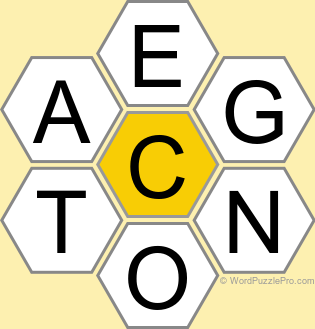
Game Summary

| Center Letter | C |
|---|---|
| Outer Letters | a, e, g, n, o, t |
| # of Pangrams | 2 (Perfect: 1) |
| Total Words | 57 words |
| Total Points | 307 points |
| Genius Level | 215 points |
| Bingo? | No |
Table of Contents
As you scroll down this page, the clues get progressively more revealing. So scroll slowly!
- Spelling Bee Grid
- Two-Letter List (2LL) Hints
- Three-Letter List (3LL) Hints
- Extra Letter Hints (Incrementally Revealing) 🤯
- Today's Complete Solution
- Answer Definitions
If you're just here for a list of NYT Spelling Bee answers, Jump down to the answers ↓ (Spoiler Alert!).
Spelling Bee Grid
The following table shows the standard Spelling Bee summary grid, which lists word lengths across the top and letters down the left-hand side. The cell where the word lengths and letters intersect displays the number of words in today's puzzle with the corresponding first letter and word length.
| 4 | 5 | 6 | 7 | 8 | 9 | 10 | 11 | Σ | |
|---|---|---|---|---|---|---|---|---|---|
| A | 1 | - | 1 | 2 | - | - | - | - | 4 |
| C | 9 | 6 | 9 | 9 | 2 | 1 | - | 1 | 37 |
| E | - | 1 | 1 | 2 | - | - | - | - | 4 |
| G | - | - | - | - | - | - | - | - | - |
| N | - | 1 | 1 | - | - | - | - | - | 2 |
| O | 1 | 2 | 2 | 1 | - | - | - | - | 6 |
| T | 2 | 1 | - | 1 | - | - | - | - | 4 | Σ | 13 | 11 | 14 | 15 | 2 | 1 | - | 1 | 57 |
Two-Letter List (2LL) Hints
The following list shows the number of solution words that begin with the corresponding two letters.
| A | AC×4 |
|---|---|
| C | CA×13 CE×2 CO×22 |
| E | EC×2 EN×2 |
| G | |
| N | NE×1 NO×1 |
| O | OC×5 ON×1 |
| T | TA×3 TO×1 |
Three-Letter List (3LL) Hints
The following list shows the number of solution words that begin with the corresponding three letters.
| A | ACC×1 ACE×2 ACN×1 |
|---|---|
| C | CAC×1 CAG×1 CAN×11 CEN×1 CET×1 COA×1 COC×3 COG×3 CON×9 COO×1 COT×5 |
| E | ECO×2 ENA×1 ENC×1 |
| G | |
| N | NEO×1 NON×1 |
| O | OCE×1 OCT×4 ONC×1 |
| T | TAC×3 TOC×1 |
Extra Letter Hints (Incrementally Revealing)
The table below lists all of the solutions to today's puzzle, but they're concealed. You can click the plus button (+) to reveal additional letters, one-by-one.
Concealed definitions are provided as additional clues. You can toggle concealment of the definitions by clicking on the concealer bar or the text that appears when the definition is visible.
Pangrams are marked with a dagger symbol (†).
| Word | 2L Ref | Definition (click to reveal) |
|---|---|---|
| co..... † | CO7 | Allied by blood; kindred by birth; specifically related on the mother's side. |
| co....... † | CO9 | In a right triangle, the reciprocal of the tangent of an angle. Symbols: cot, ctg, or ctn |
| ac.... | AC6 | A higher-pitched or stronger (louder or longer) articulation of a particular syllable of a word or phrase in order to distinguish it from the others or to emphasize it. |
| ac..... | AC7 | Any salt or ester of acetic acid. |
| ac..... | AC7 | A colourless, volatile, flammable liquid ketone, (CH3)2CO, used as a solvent. |
| ac.. | AC4 | A skin condition, usually of the face, that is common in adolescents. It is characterised by red pimples, and is caused by the inflammation of sebaceous glands through bacterial infection. |
| ca... | CA5 | A tree, Theobroma cacao, whose seed is used to make chocolate. |
| ca.. | CA4 | An enclosure made of bars, normally to hold animals. |
| ca.... | CA6 | A high-kicking chorus line dance originating in France. |
| ca.. | CA4 | A plant with simple stems, like bamboo or sugar cane, or the stem thereof The slender, flexible main stem of a plant such as bamboo, including many species in the grass family Gramineae |
| ca... | CA5 | Any member of the genus Canna of tropical plants with large leaves and often showy flowers. |
| ca.... | CA6 | A complete assembly, consisting of an artillery tube and a breech mechanism, firing mechanism or base cap, which is a component of a gun, howitzer or mortar. It may include muzzle appendages. |
| ca.... | CA6 | Can not (be unable to). |
| ca... | CA5 | A small long and narrow boat, propelled by one or more people (depending on the size of canoe), using single-bladed paddles. The paddlers face in the direction of travel, in either a seated position, or kneeling on the bottom of the boat. Canoes are open on top, and pointed at both ends. |
| ca... | CA5 | A generally accepted principle; a rule. |
| ca.. | CA4 | An argot, the jargon of a particular class or subgroup. |
| ca..... | CA7 | A vocal composition accompanied by instruments and generally containing more than one movement, typical of 17th and 18th century Italian music. |
| ca..... | CA7 | A small cafeteria or snack bar, especially one in a military establishment, school, or place of work. |
| ca.... | CA6 | A division of a political unit. One of the states comprising the Swiss Confederation. A subdivision of an arrondissement of France. A division of Luxembourg, Federation of Bosnia and Herzegovina, etc. A subdivision of a county, of Quebec, Canada; equivalent to a township. |
| ce.. | CE4 | A subunit of currency equal to one-hundredth of the main unit of currency in many countries. Symbol: ¢. |
| ce...... | CE8 | Pertaining to the zoologic order Cetacea, or associated with species falling under that taxonomic hierarchy. |
| co.. | CO4 | An outer garment covering the upper torso and arms. |
| co.. | CO4 | Any of the four cultivated plants which belong to the family Erythroxylaceae, native to western South America. |
| co... | CO5 | The dried and partially fermented fatty seeds of the cacao tree from which chocolate is made. |
| co.... | CO6 | The silky protective case spun by the larvae of some insects in which they metamorphose, the pupa. |
| co.... | CO6 | Reasonable and convincing; based on evidence. |
| co.... | CO6 | A brandy distilled from white wine in the region around Cognac in France. |
| co......... | CO11 | To join or link together, as though in a chain. |
| co..... | CO7 | To prepare something by mixing various ingredients, especially to prepare food for cooking. |
| co.. | CO4 | A surface of revolution formed by rotating a segment of a line around another line that intersects the first line. |
| co... | CO5 | A tall, narrow, single-headed Cuban hand drum of African origin. |
| co.... | CO6 | Leave, formal permission for some action, : Formal permission to leave; a passport. |
| co..... | CO7 | To join (to another object): to attach, or to be intended to attach or capable of attaching, to another object. |
| co..... | CO7 | To signify beyond its literal or principal meaning. |
| co..... | CO7 | The act of touching physically; being in close association. |
| co..... | CO7 | Satisfied, pleased, contented. |
| co.. | CO4 | Any of various aquatic birds of the genus Fulica that are mainly black with a prominent frontal shield on the forehead. |
| co.. | CO4 | A cottage or hut. |
| co...... | CO8 | A person who shares a tenancy with another; a co-owner of an interest in property. |
| co..... | CO7 | A small house. |
| co.... | CO6 | Gossypium, a genus of plant used as a source of cotton fiber. |
| ec..... | EC7 | The commission of usually illegal acts of sabotage motivated by environmentalism. |
| ec..... | EC7 | a transition area between two adjacent ecological communities (ecosystems). |
| en... | EN5 | to make (a bill) into law |
| en.... | EN6 | To lock inside a cage; to imprison. |
| ne.... | NE6 | A neoconservative. |
| no... | NO5 | The one or single occasion; the present reason or purpose (now only in for the nonce). |
| oc... | OC5 | One of the large bodies of water separating the continents. |
| oc..... | OC7 | A polygon with eight sides and eight angles. |
| oc.... | OC6 | Any of the eighteen isomeric aliphatic hydrocarbons (C8H18) found in petroleum, especially an iso-octane 2,2,4 trimethyl-pentane; they are used as fuels and solvents. |
| oc.... | OC6 | The eighth part of a circle; an arc of 45 degrees. |
| oc... | OC5 | A group or set of eight of something. |
| on.. | ON4 | One and only one time. |
| ta... | TA5 | An instruction indicating silence on the part of the performers of a piece. |
| ta.. | TA4 | A Mexican snack food made of a small tortilla (soft or hard shelled) filled with ingredients such as meat, rice, beans, cheese, diced vegetables and salsa. |
| ta.. | TA4 | The sense of touch; feeling. |
| to..... | TO7 | A piece of music (usually for a keyboard instrument) designed to emphasise the dexterity of the performer. |
Today's Complete Solution
The words that follow are a complete listing of all acceptable words in today's New York Time Spelling Bee puzzle.
Next to the answer word you'll see the two-letter reference (2L Ref) in parentheses. We added that 2L Ref for easier translation of the spoiler-avoidant language you see on the Spelling Bee Forum and Twitter. The 2L Ref signifies a word's two start letters followed by the total number of letters in the word.
- cognate† (CO7)
- cotangent† (CO9)
- accent (AC6)
- acetate (AC7)
- acetone (AC7)
- acne (AC4)
- cacao (CA5)
- cage (CA4)
- cancan (CA6)
- cane (CA4)
- canna (CA5)
- cannon (CA6)
- cannot (CA6)
- canoe (CA5)
- canon (CA5)
- cant (CA4)
- cantata (CA7)
- canteen (CA7)
- canton (CA6)
- cent (CE4)
- cetacean (CE8)
- coat (CO4)
- coca (CO4)
- cocoa (CO5)
- cocoon (CO6)
- cogent (CO6)
- cognac (CO6)
- concatenate (CO11)
- concoct (CO7)
- cone (CO4)
- conga (CO5)
- congee (CO6)
- connect (CO7)
- connote (CO7)
- contact (CO7)
- content (CO7)
- coot (CO4)
- cote (CO4)
- cotenant (CO8)
- cottage (CO7)
- cotton (CO6)
- ecotage (EC7)
- ecotone (EC7)
- enact (EN5)
- encage (EN6)
- neocon (NE6)
- nonce (NO5)
- ocean (OC5)
- octagon (OC7)
- octane (OC6)
- octant (OC6)
- octet (OC5)
- once (ON4)
- tacet (TA5)
- taco (TA4)
- tact (TA4)
- toccata (TO7)
Answer Definitions
- cognate† (adjective): Allied by blood; kindred by birth; specifically related on the mother's side.
- cotangent† (noun): In a right triangle, the reciprocal of the tangent of an angle. Symbols: cot, ctg, or ctn
- accent (noun): A higher-pitched or stronger (louder or longer) articulation of a particular syllable of a word or phrase in order to distinguish it from the others or to emphasize it.
- acetate (noun): Any salt or ester of acetic acid.
- acetone (noun): A colourless, volatile, flammable liquid ketone, (CH3)2CO, used as a solvent.
- acne (noun): A skin condition, usually of the face, that is common in adolescents. It is characterised by red pimples, and is caused by the inflammation of sebaceous glands through bacterial infection.
- cacao (noun): A tree, Theobroma cacao, whose seed is used to make chocolate.
- cage (noun): An enclosure made of bars, normally to hold animals.
- cancan (noun): A high-kicking chorus line dance originating in France.
- cane (noun): A plant with simple stems, like bamboo or sugar cane, or the stem thereof The slender, flexible main stem of a plant such as bamboo, including many species in the grass family Gramineae
- canna (noun): Any member of the genus Canna of tropical plants with large leaves and often showy flowers.
- cannon (noun): A complete assembly, consisting of an artillery tube and a breech mechanism, firing mechanism or base cap, which is a component of a gun, howitzer or mortar. It may include muzzle appendages.
- cannot (verb): Can not (be unable to).
- canoe (noun): A small long and narrow boat, propelled by one or more people (depending on the size of canoe), using single-bladed paddles. The paddlers face in the direction of travel, in either a seated position, or kneeling on the bottom of the boat. Canoes are open on top, and pointed at both ends.
- canon (noun): A generally accepted principle; a rule.
- cant (noun): An argot, the jargon of a particular class or subgroup.
- cantata (noun): A vocal composition accompanied by instruments and generally containing more than one movement, typical of 17th and 18th century Italian music.
- canteen (noun): A small cafeteria or snack bar, especially one in a military establishment, school, or place of work.
- canton (noun): A division of a political unit. One of the states comprising the Swiss Confederation. A subdivision of an arrondissement of France. A division of Luxembourg, Federation of Bosnia and Herzegovina, etc. A subdivision of a county, of Quebec, Canada; equivalent to a township.
- cent (noun): A subunit of currency equal to one-hundredth of the main unit of currency in many countries. Symbol: ¢.
- cetacean (adjective): Pertaining to the zoologic order Cetacea, or associated with species falling under that taxonomic hierarchy.
- coat (noun): An outer garment covering the upper torso and arms.
- coca (noun): Any of the four cultivated plants which belong to the family Erythroxylaceae, native to western South America.
- cocoa (noun): The dried and partially fermented fatty seeds of the cacao tree from which chocolate is made.
- cocoon (noun): The silky protective case spun by the larvae of some insects in which they metamorphose, the pupa.
- cogent (adjective): Reasonable and convincing; based on evidence.
- cognac (noun): A brandy distilled from white wine in the region around Cognac in France.
- concatenate (verb): To join or link together, as though in a chain.
- concoct (verb): To prepare something by mixing various ingredients, especially to prepare food for cooking.
- cone (noun): A surface of revolution formed by rotating a segment of a line around another line that intersects the first line.
- conga (noun): A tall, narrow, single-headed Cuban hand drum of African origin.
- congee (noun): Leave, formal permission for some action, : Formal permission to leave; a passport.
- connect (verb): To join (to another object): to attach, or to be intended to attach or capable of attaching, to another object.
- connote (verb): To signify beyond its literal or principal meaning.
- contact (noun): The act of touching physically; being in close association.
- content (adjective): Satisfied, pleased, contented.
- coot (noun): Any of various aquatic birds of the genus Fulica that are mainly black with a prominent frontal shield on the forehead.
- cote (noun): A cottage or hut.
- cotenant (noun): A person who shares a tenancy with another; a co-owner of an interest in property.
- cottage (noun): A small house.
- cotton (noun): Gossypium, a genus of plant used as a source of cotton fiber.
- ecotage (noun): The commission of usually illegal acts of sabotage motivated by environmentalism.
- ecotone (noun): a transition area between two adjacent ecological communities (ecosystems).
- enact (verb): to make (a bill) into law
- encage (verb): To lock inside a cage; to imprison.
- neocon (noun): A neoconservative.
- nonce (noun): The one or single occasion; the present reason or purpose (now only in for the nonce).
- ocean (noun): One of the large bodies of water separating the continents.
- octagon (noun): A polygon with eight sides and eight angles.
- octane (noun): Any of the eighteen isomeric aliphatic hydrocarbons (C8H18) found in petroleum, especially an iso-octane 2,2,4 trimethyl-pentane; they are used as fuels and solvents.
- octant (noun): The eighth part of a circle; an arc of 45 degrees.
- octet (noun): A group or set of eight of something.
- once (adverb): One and only one time.
- tacet (verb): An instruction indicating silence on the part of the performers of a piece.
- taco (noun): A Mexican snack food made of a small tortilla (soft or hard shelled) filled with ingredients such as meat, rice, beans, cheese, diced vegetables and salsa.
- tact (noun): The sense of touch; feeling.
- toccata (noun): A piece of music (usually for a keyboard instrument) designed to emphasise the dexterity of the performer.