NYT Spelling Bee Answers for March 11, 2025
Game Summary

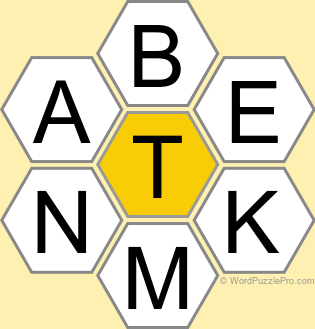
| Center Letter | T |
|---|---|
| Outer Letters | a, b, e, k, m, n |
| # of Pangrams | 1 (Perfect: none) |
| Total Words | 52 words |
| Total Points | 223 points |
| Genius Level | 156 points |
| Bingo? | Yes |
Table of Contents
As you scroll down this page, the clues get progressively more revealing. So scroll slowly!
- Spelling Bee Grid
- Two-Letter List (2LL) Hints
- Three-Letter List (3LL) Hints
- Extra Letter Hints (Incrementally Revealing) 🤯
- Today's Complete Solution
- Answer Definitions
If you're just here for a list of NYT Spelling Bee answers, Jump down to the answers ↓ (Spoiler Alert!).
Spelling Bee Grid
The following table shows the standard Spelling Bee summary grid, which lists word lengths across the top and letters down the left-hand side. The cell where the word lengths and letters intersect displays the number of words in today's puzzle with the corresponding first letter and word length.
| 4 | 5 | 6 | 7 | 8 | 9 | 10 | Σ | |
|---|---|---|---|---|---|---|---|---|
| A | 2 | 1 | - | 1 | 2 | 1 | - | 7 |
| B | 5 | - | 4 | 1 | - | 1 | - | 11 |
| E | - | 1 | - | 2 | - | - | 1 | 4 |
| K | - | 1 | 1 | - | - | - | - | 2 |
| M | 5 | 3 | 1 | 1 | - | - | - | 10 |
| N | 1 | - | 2 | - | - | - | - | 3 |
| T | 9 | 3 | 1 | - | 2 | - | - | 15 | Σ | 22 | 9 | 9 | 5 | 4 | 2 | 1 | 52 |
Two-Letter List (2LL) Hints
The following list shows the number of solution words that begin with the corresponding two letters.
| A | AB×4 AN×3 |
|---|---|
| B | BA×4 BE×7 |
| E | EA×1 EM×2 EN×1 |
| K | KA×1 KE×1 |
| M | MA×4 ME×6 |
| N | NA×1 NE×2 |
| T | TA×5 TE×10 |
Three-Letter List (3LL) Hints
The following list shows the number of solution words that begin with the corresponding three letters.
| A | ABA×2 ABE×2 ANT×3 |
|---|---|
| B | BAN×1 BAT×3 BEA×2 BEE×1 BEN×1 BET×3 |
| E | EAT×1 EMA×1 EMB×1 ENT×1 |
| K | KAT×1 KEN×1 |
| M | MAN×2 MAT×2 MEA×2 MEE×1 MEN×1 MET×2 |
| N | NAT×1 NEA×2 |
| T | TAK×2 TAM×1 TAN×2 TEA×4 TEE×2 TEN×4 |
Extra Letter Hints (Incrementally Revealing)
The table below lists all of the solutions to today's puzzle, but they're concealed. You can click the plus button (+) to reveal additional letters, one-by-one.
Concealed definitions are provided as additional clues. You can toggle concealment of the definitions by clicking on the concealer bar or the text that appears when the definition is visible.
Pangrams are marked with a dagger symbol (†).
| Word | 2L Ref | Definition (click to reveal) |
|---|---|---|
| em........ † | EM10 | a long mound of earth, stone, or similar material, usually built for purposes such as to hold back or store water, for protection from weather or enemies, or to support a road or railway. |
| ab... | AB5 | To lessen (something) in force or intensity; to moderate. |
| ab....... | AB9 | A lessening, diminution, or reduction; a moderation; removal or putting an end to. |
| ab.. | AB4 | To urge on, stimulate (a person to do) something desirable. |
| ab...... | AB8 | The act of abetting or assisting in a crime, wrongdoing etc. |
| an.. | AN4 | A price or cost, as in up the ante. |
| an..... | AN7 | A feeler organ on the head of an insect, crab, or other animal. |
| an...... | AN8 | plural of antenna |
| ba.... | BA6 | Any of several small chickens, especially of a breed that is a miniature version of another breed. |
| ba.. | BA4 | To reduce the force of something; to abate. |
| ba....... | BA9 | A ballet move involving a beating action with an extended leg |
| ba.... | BA6 | To become better; improve in condition, especially by feeding. |
| be.. | BE4 | A stroke; a blow. |
| be.... | BE6 | Defeated. |
| be.. | BE4 | Beta vulgaris, a plant with a swollen root which is eaten or used to make sugar. |
| be.. | BE4 | simple past tense and past participle of bend |
| be.. | BE4 | The second letter of the Greek alphabet (Β, β), preceded by alpha (Α, α) and followed by gamma, (Γ, γ). In modern Greek it represents the voiced labiodental fricative sound of v found in the English words have and vase. |
| be.... | BE6 | To beteach. |
| be..... | BE7 | past participle of betake |
| ea... | EA5 | past participle of eat |
| em..... | EM7 | To come from a source; issue from. |
| en..... | EN7 | An informal alliance or friendly understanding between two states. |
| ka.... | KA6 | A type of Japanese longsword or 日本刀 (nihontō), having a single edge and slight curvature, historically used by samurai and ninja. |
| ke... | KE5 | A type of fabric made of interwoven cloth strips, native to Ghana. |
| ma..... | MA7 | Any of several plant-eating marine mammals, of family Trichechidae, found in tropical regions. |
| ma... | MA5 | A kind of fabric or blanket used in Latin America and southwestern United States. |
| ma.. | MA4 | A fellow, comrade, colleague, partner or someone with whom something is shared, e.g. shipmate, classmate. |
| ma... | MA5 | A decorative border around a picture used to inset and center the contents of a frame. |
| me... | ME5 | simple past tense and past participle of mean |
| me.. | ME4 | The flesh (muscle tissue) of an animal used as food. |
| me.. | ME4 | To make contact (with) while in proximity. To come face to face with by accident; to encounter. |
| me.... | ME6 | A person who is being mentored |
| me.. | ME4 | Self-referential; structured analogously (structured by relationships), but at a higher level. |
| me.. | ME4 | To measure. |
| na.... | NA6 | floating or swimming (in water) |
| ne.. | NE4 | Clean, tidy; free from dirt or impurities. |
| ne.... | NE6 | To make (someone or something) neat; to arrange (people or things) in an orderly, tidy way; to tidy. |
| ta.. | TA4 | To get into one's hands, possession, or control, with or without force. |
| ta... | TA5 | Infatuated; fond of or attracted to. |
| ta.. | TA4 | Not or no longer wild; domesticated. |
| ta.. | TA4 | A closed container for liquids or gases. |
| ta... | TA5 | A form of Japanese verse in five lines of 5, 7, 5, 7, and 7 morae. |
| te.. | TE4 | An extremely durable timber highly valued for shipbuilding and other purposes, yielded by Tectona grandis (and Tectona spp.). |
| te.. | TE4 | A set of draught animals, such as two horses in front of a carriage. |
| te...... | TE8 | One who is on the same team. |
| te.. | TE4 | The projection of a mammary gland from which, on female mammals, milk is secreted. |
| te.. | TE4 | To be stocked to overflowing. |
| te.. | TE4 | Synonym of teenager: a person between 13 and 19 years old. |
| te.... | TE6 | One who holds a lease (a tenancy). |
| te...... | TE8 | A building that is rented to multiple tenants, especially a low-rent, run-down one. |
| te... | TE5 | An opinion, belief, or principle that is held as absolute truth by someone or especially an organization. |
| te.. | TE4 | A pavilion or portable lodge consisting of skins, canvas, or some strong cloth, stretched and sustained by poles, used for sheltering people from the weather. |
Today's Complete Solution
The words that follow are a complete listing of all acceptable words in today's New York Time Spelling Bee puzzle.
Next to the answer word you'll see the two-letter reference (2L Ref) in parentheses. We added that 2L Ref for easier translation of the spoiler-avoidant language you see on the Spelling Bee Forum and Twitter. The 2L Ref signifies a word's two start letters followed by the total number of letters in the word.
- embankment† (EM10)
- abate (AB5)
- abatement (AB9)
- abet (AB4)
- abetment (AB8)
- ante (AN4)
- antenna (AN7)
- antennae (AN8)
- bantam (BA6)
- bate (BA4)
- battement (BA9)
- batten (BA6)
- beat (BE4)
- beaten (BE6)
- beet (BE4)
- bent (BE4)
- beta (BE4)
- betake (BE6)
- betaken (BE7)
- eaten (EA5)
- emanate (EM7)
- entente (EN7)
- katana (KA6)
- kente (KE5)
- manatee (MA7)
- manta (MA5)
- mate (MA4)
- matte (MA5)
- meant (ME5)
- meat (ME4)
- meet (ME4)
- mentee (ME6)
- meta (ME4)
- mete (ME4)
- natant (NA6)
- neat (NE4)
- neaten (NE6)
- take (TA4)
- taken (TA5)
- tame (TA4)
- tank (TA4)
- tanka (TA5)
- teak (TE4)
- team (TE4)
- teammate (TE8)
- teat (TE4)
- teem (TE4)
- teen (TE4)
- tenant (TE6)
- tenement (TE8)
- tenet (TE5)
- tent (TE4)
Answer Definitions
- embankment† (noun): a long mound of earth, stone, or similar material, usually built for purposes such as to hold back or store water, for protection from weather or enemies, or to support a road or railway.
- abate (verb): To lessen (something) in force or intensity; to moderate.
- abatement (noun): A lessening, diminution, or reduction; a moderation; removal or putting an end to.
- abet (verb): To urge on, stimulate (a person to do) something desirable.
- abetment (noun): The act of abetting or assisting in a crime, wrongdoing etc.
- ante (noun): A price or cost, as in up the ante.
- antenna (noun): A feeler organ on the head of an insect, crab, or other animal.
- antennae (noun): plural of antenna
- bantam (noun): Any of several small chickens, especially of a breed that is a miniature version of another breed.
- bate (verb): To reduce the force of something; to abate.
- battement (noun): A ballet move involving a beating action with an extended leg
- batten (verb): To become better; improve in condition, especially by feeding.
- beat (noun): A stroke; a blow.
- beaten (adjective): Defeated.
- beet (noun): Beta vulgaris, a plant with a swollen root which is eaten or used to make sugar.
- bent (verb): simple past tense and past participle of bend
- beta (noun): The second letter of the Greek alphabet (Β, β), preceded by alpha (Α, α) and followed by gamma, (Γ, γ). In modern Greek it represents the voiced labiodental fricative sound of v found in the English words have and vase.
- betake (verb): To beteach.
- betaken (verb): past participle of betake
- eaten (verb): past participle of eat
- emanate (verb): To come from a source; issue from.
- entente (noun): An informal alliance or friendly understanding between two states.
- katana (noun): A type of Japanese longsword or 日本刀 (nihontō), having a single edge and slight curvature, historically used by samurai and ninja.
- kente (noun): A type of fabric made of interwoven cloth strips, native to Ghana.
- manatee (noun): Any of several plant-eating marine mammals, of family Trichechidae, found in tropical regions.
- manta (noun): A kind of fabric or blanket used in Latin America and southwestern United States.
- mate (noun): A fellow, comrade, colleague, partner or someone with whom something is shared, e.g. shipmate, classmate.
- matte (noun): A decorative border around a picture used to inset and center the contents of a frame.
- meant (verb): simple past tense and past participle of mean
- meat (noun): The flesh (muscle tissue) of an animal used as food.
- meet (verb): To make contact (with) while in proximity. To come face to face with by accident; to encounter.
- mentee (noun): A person who is being mentored
- meta (adjective): Self-referential; structured analogously (structured by relationships), but at a higher level.
- mete (verb): To measure.
- natant (adjective): floating or swimming (in water)
- neat (adjective): Clean, tidy; free from dirt or impurities.
- neaten (verb): To make (someone or something) neat; to arrange (people or things) in an orderly, tidy way; to tidy.
- take (verb): To get into one's hands, possession, or control, with or without force.
- taken (adjective): Infatuated; fond of or attracted to.
- tame (adjective): Not or no longer wild; domesticated.
- tank (noun): A closed container for liquids or gases.
- tanka (noun): A form of Japanese verse in five lines of 5, 7, 5, 7, and 7 morae.
- teak (noun): An extremely durable timber highly valued for shipbuilding and other purposes, yielded by Tectona grandis (and Tectona spp.).
- team (noun): A set of draught animals, such as two horses in front of a carriage.
- teammate (noun): One who is on the same team.
- teat (noun): The projection of a mammary gland from which, on female mammals, milk is secreted.
- teem (verb): To be stocked to overflowing.
- teen (noun): Synonym of teenager: a person between 13 and 19 years old.
- tenant (noun): One who holds a lease (a tenancy).
- tenement (noun): A building that is rented to multiple tenants, especially a low-rent, run-down one.
- tenet (noun): An opinion, belief, or principle that is held as absolute truth by someone or especially an organization.
- tent (noun): A pavilion or portable lodge consisting of skins, canvas, or some strong cloth, stretched and sustained by poles, used for sheltering people from the weather.