NYT Spelling Bee Answers for September 21, 2024
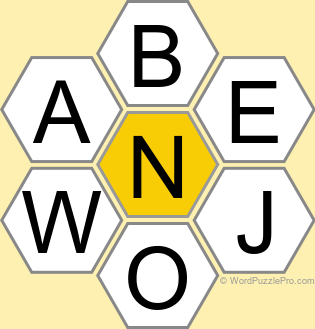
Game Summary

| Center Letter | N |
|---|---|
| Outer Letters | a, b, e, j, o, w |
| # of Pangrams | 1 (Perfect: 1) |
| Total Words | 28 words |
| Total Points | 79 points |
| Genius Level | 55 points |
| Bingo? | No |
Table of Contents
As you scroll down this page, the clues get progressively more revealing. So scroll slowly!
- Spelling Bee Grid
- Two-Letter List (2LL) Hints
- Three-Letter List (3LL) Hints
- Extra Letter Hints (Incrementally Revealing) 🤯
- Today's Complete Solution
- Answer Definitions
If you're just here for a list of NYT Spelling Bee answers, Jump down to the answers ↓ (Spoiler Alert!).
Spelling Bee Grid
The following table shows the standard Spelling Bee summary grid, which lists word lengths across the top and letters down the left-hand side. The cell where the word lengths and letters intersect displays the number of words in today's puzzle with the corresponding first letter and word length.
| 4 | 5 | 6 | 7 | Σ | |
|---|---|---|---|---|---|
| A | 3 | - | - | - | 3 |
| B | 5 | 1 | 4 | - | 10 |
| E | 1 | - | - | - | 1 |
| J | 1 | - | - | 1 | 2 |
| N | 7 | 1 | - | - | 8 |
| O | - | - | - | - | - |
| W | 2 | 1 | - | 1 | 4 | Σ | 19 | 3 | 4 | 2 | 28 |
Two-Letter List (2LL) Hints
The following list shows the number of solution words that begin with the corresponding two letters.
| A | AE×1 AN×2 |
|---|---|
| B | BA×4 BE×2 BO×4 |
| E | EB×1 |
| J | JA×1 JE×1 |
| N | NA×3 NE×2 NO×3 |
| O | |
| W | WA×3 WE×1 |
Three-Letter List (3LL) Hints
The following list shows the number of solution words that begin with the corresponding three letters.
| A | AEO×1 ANE×1 ANO×1 |
|---|---|
| B | BAB×1 BAN×3 BEA×1 BEE×1 BON×3 BOO×1 |
| E | EBO×1 |
| J | JAW×1 JEA×1 |
| N | NAA×1 NAB×1 NAN×1 NEN×1 NEO×1 NON×1 NOO×2 |
| O | |
| W | WAN×3 WEA×1 |
Extra Letter Hints (Incrementally Revealing)
The table below lists all of the solutions to today's puzzle, but they're concealed. You can click the plus button (+) to reveal additional letters, one-by-one.
Concealed definitions are provided as additional clues. You can toggle concealment of the definitions by clicking on the concealer bar or the text that appears when the definition is visible.
Pangrams are marked with a dagger symbol (†).
| Word | 2L Ref | Definition (click to reveal) |
|---|---|---|
| ja..... † | JA7 | The bone of the lower jaw; the mandible. |
| ae.. | AE4 | Alternative spelling of eon |
| an.. | AN4 | Again, once more; afresh, in a new way, newly. |
| an.. | AN4 | Straight away; at once. |
| ba.... | BA6 | An Old World monkey of the genus Papio, having dog-like muzzles and large canine teeth, cheek pouches, a short tail, and naked callosities on the buttocks. |
| ba.... | BA6 | An elongated curved tropical fruit of a banana plant, which grows in bunches and has a creamy flesh and a smooth skin. In particular, the sweet, yellow fruit of the Cavendish banana cultivar, which may be eaten raw, as distinct from e.g. a plantain for cooking. |
| ba.. | BA4 | A cause of misery or death. |
| ba... | BA5 | A stringed musical instrument (chordophone), usually with a round body, a membrane-like soundboard and a fretted neck, played by plucking or strumming the strings. |
| be.. | BE4 | Any plant of several genera of the taxonomic family Fabaceae that produces large edible seeds or edible seedpods. |
| be.. | BE4 | past participle of be. |
| bo.... | BO6 | A sweet, especially a small chocolate-covered candy. |
| bo.. | BO4 | A composite material consisting largely of calcium phosphate and collagen and making up the skeleton of most vertebrates. |
| bo.... | BO6 | The pygmy chimpanzee, Pan paniscus, from Africa south of the Congo river. |
| bo.. | BO4 | A prayer; petition. |
| eb.. | EB4 | (now poetic) Ebony; an ebony tree. |
| je.. | JE4 | Denim. |
| na.. | NA4 | A type of round, flat bread baked in a tandoor popular in South and Central Asian cuisine. |
| na... | NA5 | An Indian ruler within the Mogul empire. |
| na.. | NA4 | A banana. |
| ne.. | NE4 | The Hawaiian goose, Branta sandvicensis, which was designated the state bird of Hawaii in 1957. |
| ne.. | NE4 | The chemical element (symbol Ne) with an atomic number of 10. The second of the noble gases, it is a colourless, odorless inert gas. |
| no.. | NO4 | Not any of a given number or group. |
| no.. | NO4 | A newb or newbie; refers to the idea that someone is new to a game, concept, or idea; implying a lack of experience. Also, in some areas the word noob can mean someone is obsessed with things. |
| no.. | NO4 | The time of day when the sun is in its zenith; twelve o'clock in the day, midday. |
| wa.. | WA4 | A gradual diminution in power, value, intensity etc. |
| wa... | WA5 | Represents a contracted pronunciation of want to. |
| wa..... | WA7 | Someone who wishes to be or do something, but lacks the qualifications or talent; an overeager amateur; an aspirant. |
| we.. | WE4 | To cease giving breast milk to an offspring; to accustom and reconcile (a child or young animal) to a want or deprivation of mother's milk; to take from the breast or udder. |
Today's Complete Solution
The words that follow are a complete listing of all acceptable words in today's New York Time Spelling Bee puzzle.
Next to the answer word you'll see the two-letter reference (2L Ref) in parentheses. We added that 2L Ref for easier translation of the spoiler-avoidant language you see on the Spelling Bee Forum and Twitter. The 2L Ref signifies a word's two start letters followed by the total number of letters in the word.
- jawbone† (JA7)
- aeon (AE4)
- anew (AN4)
- anon (AN4)
- baboon (BA6)
- banana (BA6)
- bane (BA4)
- banjo (BA5)
- bean (BE4)
- been (BE4)
- bonbon (BO6)
- bone (BO4)
- bonobo (BO6)
- boon (BO4)
- ebon (EB4)
- jean (JE4)
- naan (NA4)
- nabob (NA5)
- nana (NA4)
- nene (NE4)
- neon (NE4)
- none (NO4)
- noob (NO4)
- noon (NO4)
- wane (WA4)
- wanna (WA5)
- wannabe (WA7)
- wean (WE4)
Answer Definitions
- jawbone† (noun): The bone of the lower jaw; the mandible.
- aeon (noun): Alternative spelling of eon
- anew (adverb): Again, once more; afresh, in a new way, newly.
- anon (adverb): Straight away; at once.
- baboon (noun): An Old World monkey of the genus Papio, having dog-like muzzles and large canine teeth, cheek pouches, a short tail, and naked callosities on the buttocks.
- banana (noun): An elongated curved tropical fruit of a banana plant, which grows in bunches and has a creamy flesh and a smooth skin. In particular, the sweet, yellow fruit of the Cavendish banana cultivar, which may be eaten raw, as distinct from e.g. a plantain for cooking.
- bane (noun): A cause of misery or death.
- banjo (noun): A stringed musical instrument (chordophone), usually with a round body, a membrane-like soundboard and a fretted neck, played by plucking or strumming the strings.
- bean (noun): Any plant of several genera of the taxonomic family Fabaceae that produces large edible seeds or edible seedpods.
- been (verb): past participle of be.
- bonbon (noun): A sweet, especially a small chocolate-covered candy.
- bone (noun): A composite material consisting largely of calcium phosphate and collagen and making up the skeleton of most vertebrates.
- bonobo (noun): The pygmy chimpanzee, Pan paniscus, from Africa south of the Congo river.
- boon (noun): A prayer; petition.
- ebon (noun): (now poetic) Ebony; an ebony tree.
- jean (noun): Denim.
- naan (noun): A type of round, flat bread baked in a tandoor popular in South and Central Asian cuisine.
- nabob (noun): An Indian ruler within the Mogul empire.
- nana (noun): A banana.
- nene (noun): The Hawaiian goose, Branta sandvicensis, which was designated the state bird of Hawaii in 1957.
- neon (noun): The chemical element (symbol Ne) with an atomic number of 10. The second of the noble gases, it is a colourless, odorless inert gas.
- none (pronoun): Not any of a given number or group.
- noob (noun): A newb or newbie; refers to the idea that someone is new to a game, concept, or idea; implying a lack of experience. Also, in some areas the word noob can mean someone is obsessed with things.
- noon (noun): The time of day when the sun is in its zenith; twelve o'clock in the day, midday.
- wane (noun): A gradual diminution in power, value, intensity etc.
- wanna (contraction): Represents a contracted pronunciation of want to.
- wannabe (noun): Someone who wishes to be or do something, but lacks the qualifications or talent; an overeager amateur; an aspirant.
- wean (verb): To cease giving breast milk to an offspring; to accustom and reconcile (a child or young animal) to a want or deprivation of mother's milk; to take from the breast or udder.